
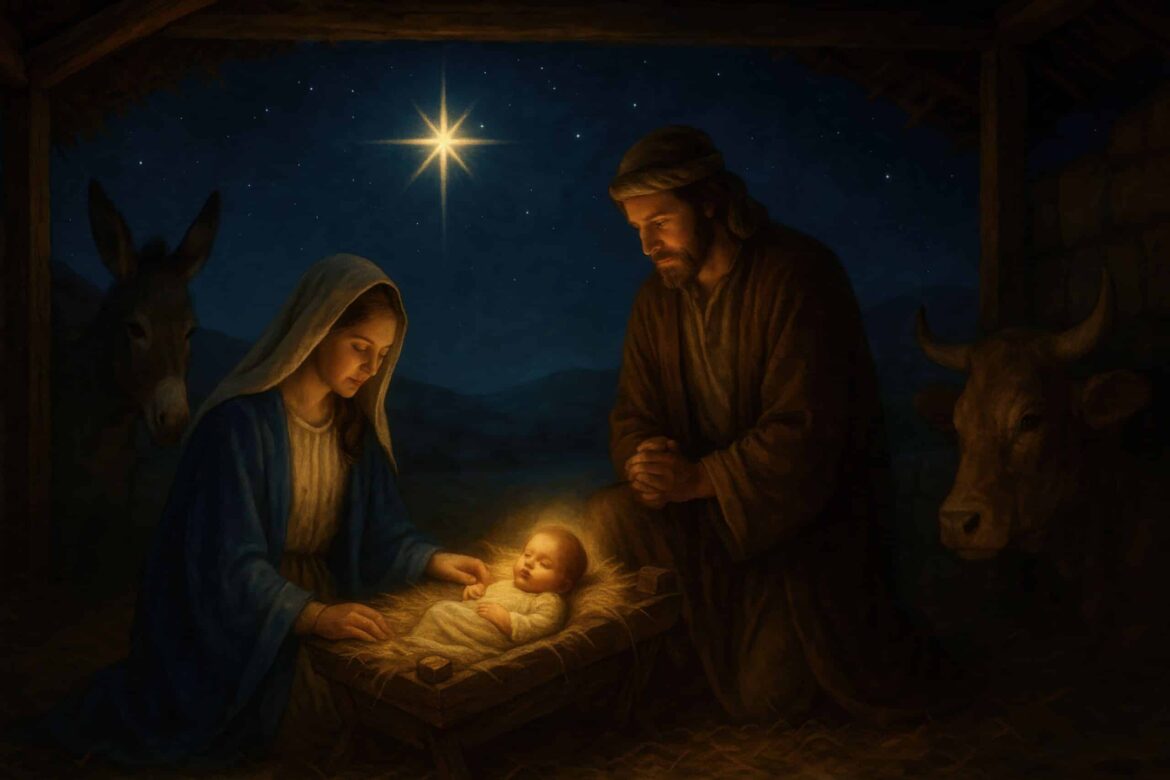
The birth of Jesus Christ is the only hope for humanity because it represents God’s answer to sin, separation, and death. Through incarnation, God entered history to redeem what humanity could not restore. Jesus was born to save, reconcile, and restore the relationship between God and man.
By Evangelist Peter Gee, Editor in Chief, Christianity News Daily
12/09/2025
Introduction
The birth of Jesus Christ is often celebrated around the world, yet widely misunderstood. Each December, cultures emphasize tradition, imagery, and sentiment while overlooking the deeper reason Christ entered human history. The four Gospels—Matthew, Mark, Luke, and John—present complementary perspectives that converge on one unshakable truth: humanity is fundamentally separated from God by sin, and only the incarnation of Jesus Christ could restore that broken relationship.
Jesus was not born merely to inspire moral reform, preserve religious customs, or improve society. He was born because humanity was spiritually dead and incapable of saving itself. The manger in Bethlehem stands as the starting point of God’s ultimate rescue mission. Without the birth of Christ, there would be no salvation, no reconciliation, and no eternal hope.
Humanity’s Greatest Problem Sin and Separation
Scripture is consistent in diagnosing humanity’s condition. “All have sinned and fall short of the glory of God” (Romans 3:23). Sin is not merely wrongdoing; it is rebellion against God that results in spiritual separation. Isaiah declares, “Your iniquities have separated you from your God” (Isaiah 59:2).
From Genesis onward, humanity’s problem was never a lack of information or innovation. It was a broken relationship with the Creator. Adam’s fall introduced death, corruption, and alienation into the human experience. Every generation since has felt the consequences.
No amount of human effort—whether religious systems, philosophical thought, or moral discipline—could erase sin. If humanity could not reach God, God would have to come to humanity. That is the reason for the birth of Jesus Christ.
The Necessity of the Incarnation
The Gospels collectively affirm that Jesus Christ was both fully God and fully man. Matthew establishes His legal right as King through David’s lineage. Luke reveals His humanity and humility. John declares His eternal divinity. Together, they confirm that salvation required incarnation.
Hebrews 2:17 explains, “Therefore, in all things He had to be made like His brethren, that He might be a merciful and faithful High Priest.” Christ had to enter human history, experience humanity, and remain sinless to become the perfect mediator between God and man.
A mere human could not pay the price for sin. A mere angel could not represent humanity. Only God in the flesh could reconcile both sides. The birth of Jesus was not optional—it was essential.
Jesus Christ the Promised Savior
The angelic announcement to the shepherds summarized the purpose of Christ’s birth: “For there is born to you this day… a Savior, who is Christ the Lord” (Luke 2:11). Salvation was the explicit reason for His coming.
Matthew records the angel’s instructions to Joseph: “You shall call His name Jesus, for He will save His people from their sins” (Matthew 1:21). Salvation was not an afterthought or later adjustment to Christ’s mission. It was the reason for His arrival.
Jesus did not come to manage sin but to remove it. John the Baptist later identified Him as “the Lamb of God who takes away the sin of the world” (John 1:29). The birth pointed directly to the cross.
Why the World Will Always Need Christ?
Modern society often views sin as outdated or offensive language, yet the symptoms remain visible—violence, injustice, broken families, corruption, addiction, and despair. Technology has advanced, but the human heart has not changed.
Jesus addressed this reality directly: “That which is born of the flesh is flesh” (John 3:6). Humanity cannot fix itself. Regeneration—not reformation—is required.
The world will always need Christ because only He offers forgiveness, transformation, and eternal life. “Nor is there salvation in any other” (Acts 4:12). The Christmas message is not about inclusion without repentance—it is about redemption through Christ alone.
The Birth That Revealed God’s Love
The incarnation is the greatest demonstration of God’s love. John 3:16 declares, “For God so loved the world that He gave His only begotten Son.” Love took form in a manger.
God did not shout instructions from heaven. He stepped into human suffering, pain, and limitation. Jesus was born into poverty, rejection, and adversity. Hebrews 4:15 reminds believers that Christ sympathizes with human weakness because He experienced it.
The birth of Jesus proves that God is not distant, indifferent, or detached. He is present, involved, and committed to humanity’s redemption.
Christ Born to Establish a New Relationship With God
Before Christ, humanity approached God through priests, sacrifices, and rituals. These systems pointed toward redemption but could not complete it. Hebrews 10:4 states that “it is not possible that the blood of bulls and goats could take away sins.”
Jesus’ birth inaugurated a new covenant. “God sent forth His Son… to redeem those who were under the law” (Galatians 4:4–5). Through Christ, believers gain direct access to God as Father.
John writes, “As many as received Him, to them He gave the right to become children of God” (John 1:12). Christmas is about adoption—not tradition.
The Cross Foreshadowed at the Manger
The gifts brought by the wise men—gold, frankincense, and myrrh—foreshadowed Christ’s identity and destiny. Myrrh, used for burial, pointed toward His sacrificial death.
Jesus Himself affirmed that He came to give His life as a ransom (Matthew 20:28). Christmas and the cross are inseparable. Without the birth, there is no crucifixion. Without the crucifixion, there is no redemption.
Christ was born with the mission to die, rise, and conquer death on behalf of humanity.
Eternal Hope Through the Resurrection
While the birth marks God’s entry into history, the resurrection confirms the victory of redemption. Paul writes, “If Christ is not risen, your faith is futile” (1 Corinthians 15:17).
Christmas without resurrection becomes sentiment. Resurrection without incarnation is impossible. Together, they form the foundation of Christian hope.
Through Christ, believers receive eternal life, not merely improved earthly circumstances. Jesus declared, “Because I live, you will live also” (John 14:19).
Christmas as a Call to Response
The birth of Jesus Christ demands a response. The wise men worshiped. The shepherds proclaimed. Herod resisted. Each response reflects a heart condition still present today.
Jesus Himself warned, “He who does not believe is condemned already” (John 3:18). Neutrality is not an option. The incarnation confronts humanity with a choice—receive the Light or remain in darkness.
Conclusion
The birth of Jesus Christ is the only hope for humanity because it represents God’s answer to sin, separation, and death. Through incarnation, God entered history to redeem what humanity could not restore. Jesus was born to save, reconcile, and restore the relationship between God and man.
Christmas is not about nostalgia or tradition. It is about salvation. The child in the manger is the Savior of the world, the Light for all nations, and the only way to God. Without Christ, humanity remains lost. With Him, eternal life is offered to all who believe.