
Today, many in the church, including youth and those raised in Christian homes, have learned to attend services but not to live as disciples. They may know church culture and music, but lack conviction, prayer, and scriptural understanding. The modern church often prioritizes relevance over repentance, hype over holiness, and inspiration over true discipleship.
By Evangelist Peter Gee for Christianity News Daily
04/09/2026
The modern church has a discipleship crisis.
Many attend church services, participate in worship, and use Christian language, yet their daily lives often lack genuine submission to Jesus Christ. Today, many seek the comfort of religion without embracing the cost of obedience, the language of faith without the discipline of holiness, and the hope of heaven without personal transformation. As a result, Christianity has become cultural or social for many, rather than the life of discipleship, self-denial, purity, truth, and daily obedience that Jesus Christ taught.
Jesus never invited people merely to admire Him. He called men and women to follow Him. He did not say, “Come and be entertained.” He said, “Follow Me.” He did not say, “Take up your preferences.” He said, “If anyone desires to come after Me, let him deny himself, and take up his cross daily, and follow Me” (Luke 9:23, NKJV).
That is discipleship.
Discipleship is not a slogan, program, or event. It is the daily surrender of one’s life to the lordship of Jesus Christ. It involves walking in the Spirit, refusing compromise, loving what God loves, and pursuing Christlikeness through obedience and perseverance.
Today, many in the church, including youth and those raised in Christian homes, have learned to attend services but not to live as disciples. They may know church culture and music, but lack conviction, prayer, and scriptural understanding. The modern church often prioritizes relevance over repentance, hype over holiness, and inspiration over true discipleship.
Jesus warned plainly that the way of life is narrow and that few find it. He said:
“Enter by the narrow gate; for wide is the gate and broad is the way that leads to destruction, and there are many who go in by it. Because narrow is the gate and difficult is the way which leads to life, and there are few who find it” (Matthew 7:13–14, NKJV).
These words serve as a warning to churches, leaders, parents, and believers. The broad path is popular and permissive, while the narrow path requires sacrifice, repentance, and leads to eternal life.
The Bible says in Romans 8:14, “For as many as are led by the Spirit of God, these are sons of God.” This means that true children of God are not defined by mere religious identity but by spiritual leadership under the Spirit of God. Those who are governed by the flesh, dominated by lust, enslaved by ungodly appetites, and unbroken in their rebellion should tremble. Scripture is clear:
“For if you live according to the flesh you will die; but if by the Spirit you put to death the deeds of the body, you will live” (Romans 8:13, NKJV).
For this reason, discipleship must be central in the church. Believers should understand that salvation does not permit ongoing sin, and that grace, love, and mercy do not negate the call to holiness and obedience. Faith without transformation is incomplete.
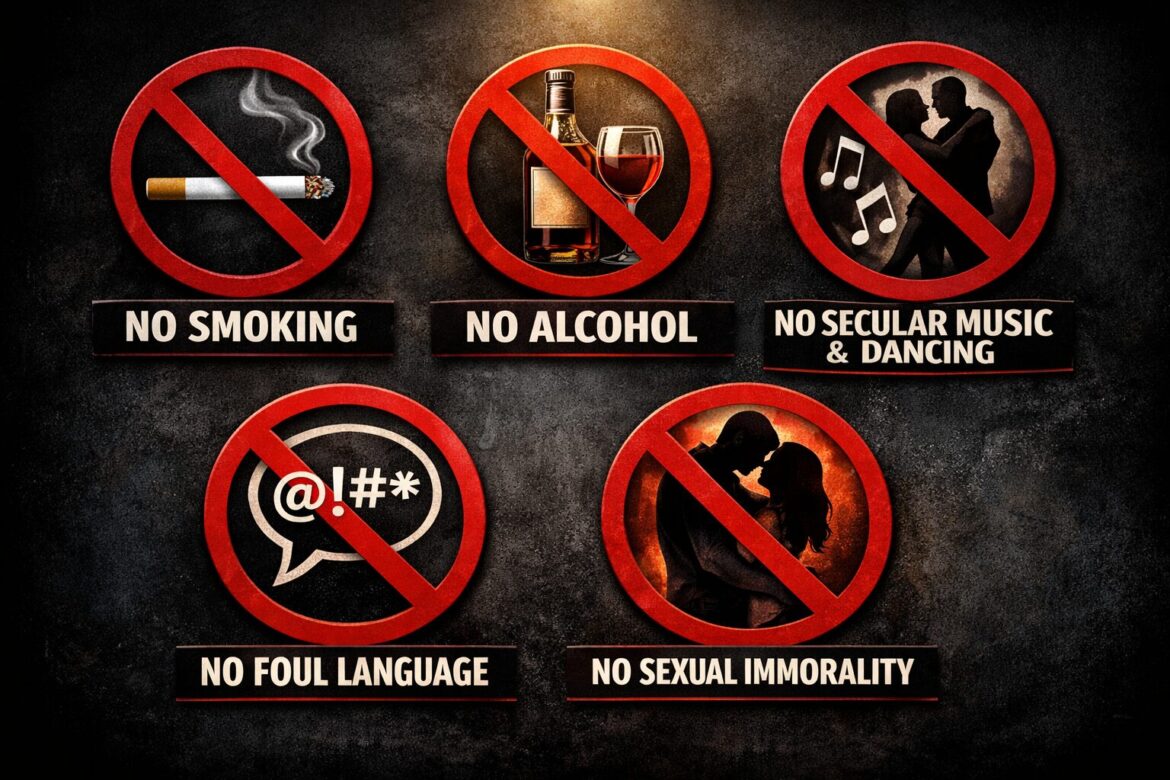
This article highlights five foundational biblical values that all believers are encouraged to practice. These are basic moral and spiritual standards relevant to all ages and backgrounds. Embracing these principles demonstrates a commitment to a Christ-centered life.
These five values are:
- No smoking
- No drinking alcohol
- No listening to or dancing to secular music.
- No cursing, swearing, or filthy language
- No fornication, adultery, or sexual immorality
These are significant issues of discipleship and holiness. The evidence of a transformed life should be visible in all who profess Christ. The church must reject worldliness and return to repentance, truth, and biblical Christianity.
1. No Smoking: The Body Is Not for Defilement but for the Lord
Disciples of Jesus Christ are encouraged to honor their bodies and avoid harmful practices. Smoking can cause health problems and dependency. Respecting the body is a way to honor God, as taught in Scripture.
The Bible says:
“Do you not know that your body is the temple of the Holy Spirit who is in you, whom you have from God, and you are not your own?”
“For you were bought at a price; therefore glorify God in your body and in your spirit, which are God’s” (1 Corinthians 6:19–20, NKJV).
A believer’s body belongs to the Lord and should not be abused or subjected to harmful habits. Smoking undermines self-control, purity, wisdom, and stewardship, and can harm both personal health and Christian witness.
Scripture says:
“All things are lawful for me, but all things are not helpful. All things are lawful for me, but I will not be brought under the power of any” (1 Corinthians 6:12, NKJV).
This is clear guidance. Even if something is not explicitly named in Scripture, disciples should ask whether it is beneficial, glorifies God, promotes holiness, or leads to mastery by harmful habits. Smoking does not meet these standards.
The Bible also teaches:
“Therefore, having these promises, beloved, let us cleanse ourselves from all filthiness of the flesh and spirit, perfecting holiness in the fear of God” (2 Corinthians 7:1, NKJV).
Smoking is the filthiness of the flesh. It is not holiness. It is not the fear of God. It is not the behavior of a disciplined saint. Christian youth especially must be warned not to treat smoking as a fashion statement, a stress reliever, or a harmless social habit. Whether cigarettes, cigars, vaping, or any similar addictive inhaled vice, the principle remains the same: the disciple is called to holiness, not defilement.
Christian parents should teach their children the importance of caring for their bodies. Church leaders and members can support one another in making healthy, faith-based choices. Grace enables believers to pursue holiness.
“For the grace of God that brings salvation has appeared to all men, teaching us that, denying ungodliness and worldly lusts, we should live soberly, righteously, and godly in the present age” (Titus 2:11–12, NKJV).
Smoking is incompatible with sober, righteous, and godly living. Believers are encouraged to reject it in pursuit of a life that reflects their faith and values.
2. No Drinking Alcohol: Sobriety Is a Christian Duty
One of the most normalized sins in modern church culture is drinking alcohol. Many Christians now defend it, celebrate it, photograph it, joke about it, serve it, and excuse it. In some places, professing believers talk more boldly about wine, cocktails, and social drinking than they talk about prayer, holiness, or evangelism. This is shameful.
The Bible calls believers to sobriety, alertness, restraint, and self-control.
“Therefore let us not sleep, as others do, but let us watch and be sober” (1 Thessalonians 5:6, NKJV).
“And do not be drunk with wine, in which is dissipation; but be filled with the Spirit” (Ephesians 5:18, NKJV).
Notice the contrast. Do not be filled with wine; be filled with the Spirit. The Christian is not to seek artificial stimulation, chemical relaxation, or fleshly excitement. The Christian is to seek the fullness of the Holy Spirit.
Alcohol has ruined homes, corrupted judgments, inflamed lust, triggered violence, destroyed marriages, broken ministries, wasted money, fueled abuse, and dragged countless souls into shame and destruction. Why then should believers play around with that which has slain so many? Proverbs speaks powerfully:
“Wine is a mocker, strong drink is a brawler, and whoever is led astray by it is not wise” (Proverbs 20:1, NKJV).
That verse alone should silence the casual Christian defense of alcohol. Whoever is led astray by it is not wise. The disciple is called to wisdom, not foolishness.
Again, Scripture says:
“Who has woe? Who has sorrow? Who has contentions? Who has complaints? Who has wounds without cause? Who has red eyes?”
“Those who linger long at the wine, those who go in search of mixed wine.”
“Do not look on the wine when it is red, when it sparkles in the cup, when it swirls around smoothly; at the last it bites like a serpent, and stings like a viper” (Proverbs 23:29–32, NKJV).
What a warning. Alcohol sparkles at the beginning and stings at the end. It promises ease but brings bondage. It offers social pleasure but often leads to moral collapse. It lowers guard. It weakens conviction. It makes temptation easier and resistance harder.
Leaders, especially, are warned:
“It is not for kings, O Lemuel, it is not for kings to drink wine, nor for princes intoxicating drink; lest they drink and forget the law, and pervert the justice of all the afflicted” (Proverbs 31:4–5, NKJV).
If rulers must avoid intoxication because of the danger to judgment, how much more believers who are called a royal priesthood in Christ? The church must return to sober-minded Christianity.
“But let us who are of the day be sober, putting on the breastplate of faith and love, and as a helmet the hope of salvation” (1 Thessalonians 5:8, NKJV).
To young people: do not let culture disciple you into social drinking. Do not let modern church trends make you comfortable with compromise. To Christian families: do not stock what God has repeatedly warned against. To believers everywhere: choose the Spirit over intoxication, conviction over culture, holiness over appetite.
3. No Listening to or Dancing to Secular Music: What Enters the Heart Shapes the Soul
Music is not neutral. Sound carries spirit, influence, emotion, imagination, memory, and desire. What people listen to enters the heart, shapes the mind, feeds the inner life, and gradually influences behavior. Secular music often glorifies lust, pride, rebellion, violence, vanity, greed, fornication, lawlessness, blasphemy, and sensuality. How can a disciple of Jesus Christ feast on such content and still claim to be guarding the heart?
The Bible says:
“Keep your heart with all diligence, for out of it spring the issues of life” (Proverbs 4:23, NKJV).
If the heart must be guarded, then believers must be careful what they permit through the ears. Many young Christians who would never openly deny Christ nevertheless corrupt their inner lives daily with ungodly music. Some dance to songs full of lust and profanity, then sing worship on Sunday as if God does not see the contradiction. But he does see.
Scripture commands:
**“Finally, brethren, whatever things are true, whatever things are noble, whatever things are just, whatever things are pure, whatever things are lovely, whatever things are of good report, if there is any virtue and if there is anything praiseworthy—meditate on these things.
4. No Cursing, Swearing, or Filthy Language: The Mouth Reveals the Heart
One of the clearest signs of spiritual decline in a person is an unclean mouth. A corrupt tongue often exposes a corrupt inner life. Many who claim to know Christ still speak with profanity, vulgarity, crude jokes, sexual slang, insults, verbal aggression, and careless, filthy expressions. Some even excuse it as humor, personality, frustration, or modern communication. But Scripture does not excuse it. God judges words. The Lord listens to conversation. The mouth matters.
Jesus said:
“For out of the abundance of the heart the mouth speaks” (Matthew 12:34, NKJV).
That means speech is not a small issue. Words do not come from nowhere. They come from within. They flow from the treasury of the heart. If the heart is full of Christ, purity, reverence, and the fear of God, the speech will increasingly reflect that. But if the heart is filled with worldliness, carnality, anger, vulgarity, and spiritual emptiness, the tongue will betray it sooner or later.
The modern generation, including many in the church, has become far too casual with profanity. The words people once trembled to say are now used openly, joked about, abbreviated, typed, posted, sung, shouted, and laughed over—even among those who identify as Christians. But the disciple of Jesus Christ must be different. The believer’s mouth must not sound like the world.
The Bible says plainly:
“Let no corrupt word proceed out of your mouth, but what is good for necessary edification, that it may impart grace to the hearers” (Ephesians 4:29, NKJV).
That verse alone is enough to expose the speech culture of much of the church today. No corrupt word. Not some. Not only in public. Not only in church. No corrupt word. Instead, the believer is to speak what is good, what builds up, what gives grace, what blesses those who hear.
Again, Scripture says:
“But now you yourselves are to put off all these: anger, wrath, malice, blasphemy, filthy language out of your mouth” (Colossians 3:8, NKJV).
Filthy language has no place in the mouth of a Christian. Not the F-word. Not the S-word. Not sexual vulgarities. Not dirty jokes. Not corrupt slang. Not hidden profanity dressed up as “expressiveness.” The child of God must not use language that dishonors the Lord and pollutes the hearer.
James speaks with holy seriousness about the tongue:
“But no man can tame the tongue. It is an unruly evil, full of deadly poison” (James 3:8, NKJV).
And again:
“With it we bless our God and Father, and with it we curse men, who have been made in the similitude of God.”
“Out of the same mouth proceed blessing and cursing. My brethren, these things ought not to be so” (James 3:9–10, NKJV).
There is the contradiction of modern church life: people bless God in worship and then curse in traffic; they quote Scripture online and then write filthy comments; they sing hymns and then laugh over dirty language; they preach in church and speak corruptly at home. James says, “These things ought not to be so.”
The disciple must understand that speech is part of holiness. Your words are not separate from your Christianity. Your text messages matter. Your social media captions matter. Your private jokes matter. Your casual speech matters. Your language before friends matters. Your language when angry matters. Your language when no one from the church is around matters. God hears it all.
Jesus warned:
“But I say to you that for every idle word men may speak, they will give account of it in the day of judgment.”
**“For by your words you will be justified, and by your words.
5. No Fornication, Adultery, or Sexual Immorality: The Body Must Belong to Christ Alone
Few sins have destroyed more souls, homes, ministries, and destinies than sexual immorality. It is one of the greatest moral plagues of our generation. Fornication, adultery, sleeping around, pornography, lust, impurity, and sexual compromise have become so common in society that many now treat them as normal. Tragically, this spirit of impurity has also deeply entered the church. Many who sing in choirs, preach sermons, lead ministries, attend youth conferences, and call themselves Christian are secretly or openly living in sexual sin. This is a terrible disgrace before the Lord.
The Bible is not silent about this matter. God speaks with force, clarity, and repeated warning. Sexual immorality is not a small weakness to be managed casually. It is a sin to be repented of, fled from, crucified, and abandoned.
Scripture says:
“For this is the will of God, your sanctification: that you should abstain from sexual immorality.”
“that each of you should know how to possess his own vessel in sanctification and honor.”
“not in passion of lust, like the Gentiles who do not know God” (1 Thessalonians 4:3–5, NKJV).
There is no confusion in that passage. The will of God is your sanctification. The will of God is that you abstain from sexual immorality. The will of God is not that Christians experiment with impurity, test boundaries, excuse passion, or imitate the world. The will of God is holiness.
Fornication—sexual relations outside marriage—is sin. Adultery—sexual unfaithfulness in marriage—is sin. Secret lust is sin. Pornography is sin. Seductive behavior is sin. Romantic impurity that inflames lust is sin. Sexual joking and sensual behavior that stir corruption are sins. God does not redefine holiness because culture changes.
Paul writes with unmistakable directness:
“Flee sexual immorality. Every sin that a man does is outside the body, but he who commits sexual immorality sins against his own body” (1 Corinthians 6:18, NKJV).
Notice that Scripture does not say manage it, negotiate with it, excuse it, or flirt with it. It says flee. Run from it. Get away from it. Cut it off. Refuse the environment, the relationship, the conversation, the media, the situation, and the habit that nourishes it. Joseph in the house of Potiphar’s wife is a model here. He did not stay to “explain himself.” He fled (Genesis 39:7–12). That is discipleship.
The body of the believer is not meant for immorality. It belongs to Christ.
“Now the body is not for sexual immorality but for the Lord, and the Lord for the body” (1 Corinthians 6:13, NKJV).
Again:
“Do you not know that your bodies are members of Christ? Shall I then take the members of Christ and make them members of a harlot? Certainly not!” (1 Corinthians 6:15, NKJV).
And again:
“Or do you not know that he who is joined to a harlot is one body with her? For ‘the two,’ He says, ‘shall become one flesh’” (1 Corinthians 6:16, NKJV).
This is why sexual sin is so serious. It is deeply defiling, deeply binding, and deeply dishonoring to Christ. The one who belongs to Jesus Christ must not join what belongs to Christ with what is unclean.
Hebrews gives another solemn warning:
“Marriage is honorable among all, and the bed undefiled; but fornicators and adulterers God will judge” (Hebrews 13:4, NKJV).
That sentence should shake the church. God will judge fornicators and adulterers. The modern world laughs at this, but heaven does not laugh. God is holy. The Judge of all the earth has not changed. Those who continue in fornication without repentance are storing up wrath for themselves. Those who treat adultery lightly are walking in deadly danger. The church must stop softening what God has spoken so strongly against.
Paul writes further:
“Do you not know that the unrighteous will not inherit the kingdom of God? Do not be deceived. Neither fornicators, nor idolaters, nor adulterers, nor homosexuals, nor sodomites.”
“nor thieves, nor covetous, nor drunkards, nor revilers, nor extortioners will inherit the kingdom of God” (1 Corinthians 6:9–10, NKJV).
These are terrifying words for a compromised generation: Do not be deceived. That means many are deceived. Many assume they can live in sexual sin and still inherit the kingdom as though discipleship and holiness are optional. But the Word says, Do not be deceived.
Now, thanks be to God, the gospel not only condemns, but it also cleanses and transforms. Paul continues:
“And such were some of you. But you were washed, but you were sanctified, but you were justified in the name of the Lord Jesus and by the Spirit of our God” (1 Corinthians 6:11, NKJV).
That is the hope of the gospel. The sexually immoral can repent. The adulterer can repent. The fornicator can repent. The unclean can repent. The defiled can repent. Christ can wash, sanctify, and justify the truly repentant sinner. But no one should presume upon grace while still loving impurity. Grace saves from sin; it does not excuse it.
Jesus Himself raised the standard even higher. He said:
“You have heard that it was said to those of old, ‘You shall not commit adultery.’”
“But I say to you that whoever looks at a woman to lust for her has already committed adultery with her in his heart” (Matthew 5:27–28, NKJV).
This means true discipleship is not only about the act but also about the heart. Christ is not after outward restraint alone. He demands inward purity. He calls believers to fight lust at the level of thought, imagination, and desire. That is why Christian youth must be taught early and firmly. Parents must not be silent. Pastors must not avoid the topic. Churches must not be embarrassed to preach holiness. A generation that is discipled by the internet, pornography, entertainment, and social media cannot survive without strong biblical teaching on sexual purity.
Job said:
“I have made a covenant with my eyes; why then should I look upon a young woman?” (Job 31:1, NKJV).
That is the language of a disciplined saint. Believers today must make covenants with their eyes, minds, phones, habits, and relationships. Do not keep ungodly conversations. Do not maintain immoral friendships that pull you downward. Do not entertain flirtation. Do not sit under media that inflames lust. Do not dress to provoke sensuality. Do not move in and out of compromise and expect spiritual power to remain.
Galatians says:
“Now the works of the flesh are evident, which are: adultery, fornication, uncleanness, lewdness” (Galatians 5:19, NKJV).
And then comes the warning:
“Those who practice such things will not inherit the kingdom of God” (Galatians 5:21, NKJV).
The keyword is practice. This refers to a lifestyle, a pattern, an unrepentant continuation. The true Christian may stumble and repent, but he does not make peace with sin. He does not defend it. He does not build a life around it. He wars against it by the Spirit of God.
Romans 8 is again essential:
“For if you live according to the flesh you will die; but if by the Spirit you put to death the deeds of the body, you will live” (Romans 8:13, NKJV).
This is the dividing line. The life of discipleship is not flesh-management but flesh-crucifixion. Sexual sin must be put to death. Not admired. Not negotiated with. Not explained away. Put to death.
To every young person in the church: keep yourself pure. Your body is not for experimentation. It is not for lust. It is not for worldly pleasure. It is for the Lord. Do not let your generation laugh you into hell. Do not let movies, music, online culture, or immoral friends shape your standards. The narrow way requires purity.
To every unmarried believer: wait on God and honor Him. Do not awaken love outside His order. Do not call fornication “love.” Do not call bondage “freedom.” Do not call lust “a relationship.” Obedience is better than passion without restraint.
To every married believer: guard your covenant. Protect your home. Flee emotional affairs, secret conversations, hidden fantasies, and every open door to adultery. Marriage is holy. God sees what is done in secret.
To the whole church: preach repentance again. Preach purity again. Preach holiness again. Preach the fear of God again. Better a hard truth that saves than a soft lie that damns.
Conclusion: The Narrow Way Still Stands
The Lord has not changed. His Word has not changed. Holiness has not changed. The requirements of discipleship have not changed.
The modern church may lower the standard, but heaven has not. Society may celebrate compromise, but God still calls His people to come out and be separate. Culture may mock purity, sobriety, clean speech, and moral discipline, but the narrow path still remains the path of life.
The five values set forth here are not extreme legalism. They are basic discipleship. They are basic Christian ethics. They are basic holiness. They are the kind of simple, clear standards that should be taught in every Christian home, every youth ministry, every discipleship class, every church, and every mission field:
- No smoking
- No drinking alcohol
- No secular music and sensual dancing
- No cursing or filthy language
- No fornication, adultery, or sexual immorality
These are not burdensome commands for those who love Christ. They are protections. They are boundaries of wisdom. They are markers of separation from the world. They are evidence of a life led by the Spirit and not governed by the flesh.
Again, the Bible says:
“For as many as are led by the Spirit of God, these are sons of God” (Romans 8:14, NKJV).
And again:
“Pursue peace with all people, and holiness, without which no one will see the Lord” (Hebrews 12:14, NKJV).
This is the urgent message to the global body of Christ: Repent of any compromise. Return where you have drifted. Cleanse your life. Guard your home. Teach your children. Warn the youth. Restore discipleship. Follow the Holy Spirit. Crucify the flesh. Walk the narrow road.
Jesus is still calling for disciples, not merely attendees. He is still calling for holiness, not hype. He is still calling for obedience, not excuses. He is still calling for repentance, not performance. And though few may choose this way, it is still the only way that leads to life.
“Enter by the narrow gate; for wide is the gate and broad is the way that leads to destruction, and there are many who go in by it.”
“Because narrow is the gate and difficult is the way which leads to life, and there are few who find it” (Matthew 7:13–14, NKJV).
May the church hear the warning. May the youth take heed. May Christian households return to biblical discipline. May sinners repent. May saints be purified. And may the Lord Jesus Christ receive a holy people prepared for His name.