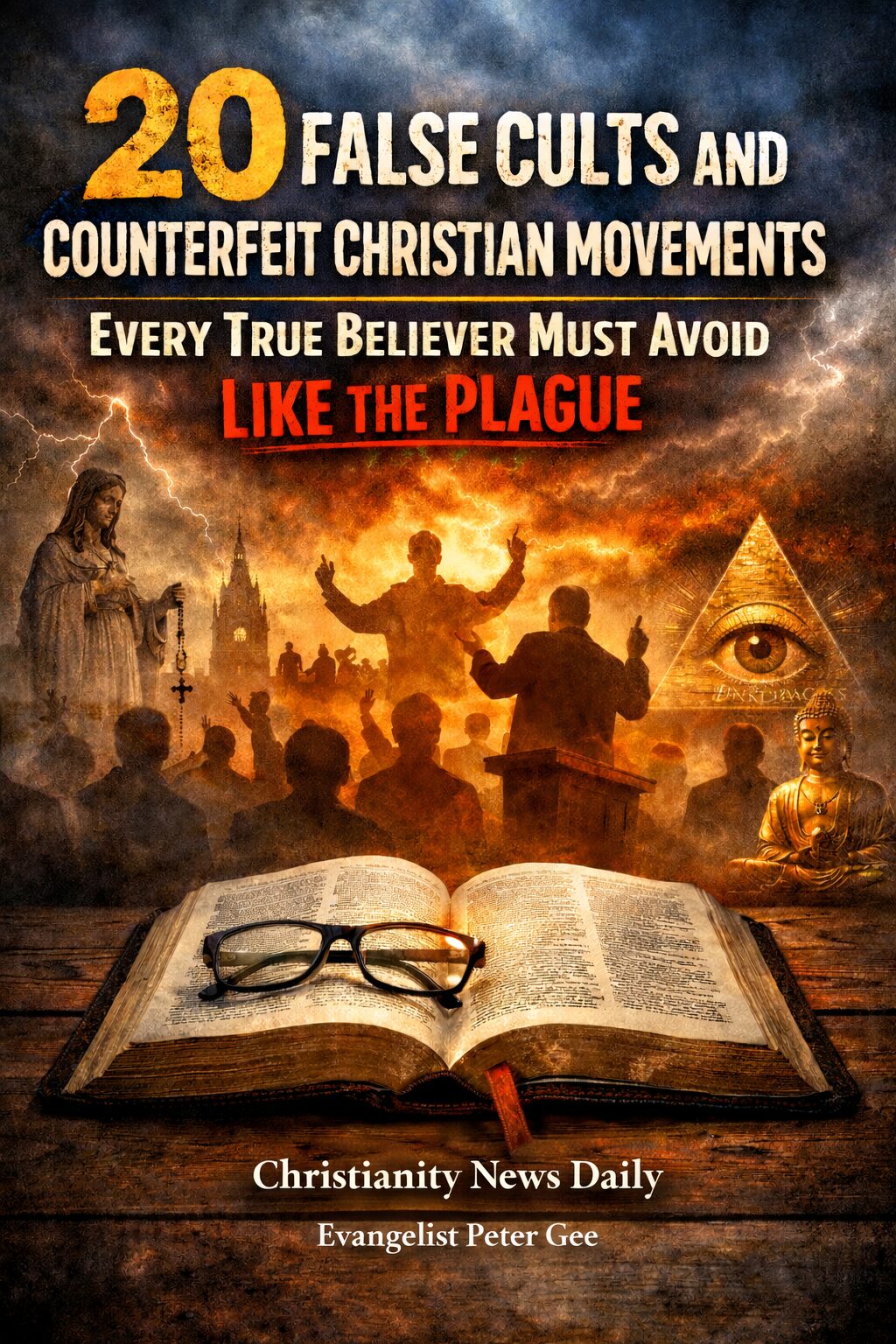
Any religion, sect, denomination, or movement that denies the true identity of Christ, adds human works to justification, elevates tradition or private revelation above Scripture, inserts other mediators between God and man, or proclaims another gospel must be tested and rejected.
By Evangelist Peter Gee, Editor in Chief, Christianity News Daily
04/20/2026
“Beloved, do not believe every spirit, but test the spirits to see whether they are of God.”
— 1 John 4:1
In every generation, Satan wages war against the truth of God by attacking the gospel of Jesus Christ. He does not always do so through blatant atheism, paganism, or open rebellion. Often, he works through counterfeit religion, false teachers, spiritual systems, and corrupted versions of Christianity that use biblical language while denying biblical truth. Scripture repeatedly warns that deception will not come merely from outside the visible church but from within its borders, clothed in religious, moral, and prophetic language, and even in the name of Christ.
The danger of false religion is not merely that it is wrong. The danger is that it appears close enough to the truth to deceive the undiscerning. Satan does not need a system to deny Jesus by name if he can instead redefine Him. He does not need to abolish the gospel if he can corrupt it. He does not need to remove the Bible if he can twist it. This is why the apostle Paul wrote with holy severity, “But even if we, or an angel from heaven, preach any other gospel to you than what we have preached to you, let him be accursed” (Galatians 1:8). The issue is not sincerity, religious tradition, antiquity, size, wealth, or emotional fervor. The issue is truth.
The Bible teaches that salvation is by grace alone, through faith in Jesus Christ alone. “For by grace you have been saved through faith, and that not of yourselves; it is the gift of God, not of works, lest anyone should boast” (Ephesians 2:8–9). Christ is not one option among many. He is “the way, the truth, and the life,” and “no one comes to the Father except through” Him (John 14:6). There is “one God and one Mediator between God and men, the Man Christ Jesus” (1 Timothy 2:5). His atoning sacrifice was sufficient, complete, final, and once for all. Hebrews 10:14 declares, “For by one offering He has perfected forever those who are being sanctified.”
Any religion, sect, denomination, or movement that denies the true identity of Christ, adds human works to justification, elevates tradition or private revelation above Scripture, inserts other mediators between God and man, or proclaims another gospel must be tested and rejected. This is not a call to hatred toward people. Christians are commanded to speak the truth in love (Ephesians 4:15), to be gentle and patient (2 Timothy 2:24–25), and to pray for those trapped in error. But love does not flatter deception. Love warns. Love discerns. Love points people back to the only Savior who can save.
Below is a biblical examination of twenty major false Christian or pseudo-Christian movements that believers should carefully test by the Word of God.
1. Roman Catholicism
Roman Catholicism presents itself as Christian, speaks often of Jesus, and affirms many biblical words and themes. Yet at the level of the gospel, it departs in serious ways from the apostolic message. Its sacramental system ties grace to ritual administration. Its theology of justification historically mixes faith with works, penance, sacramental participation, and ecclesiastical mediation. It places extraordinary veneration upon Mary and the saints, promotes prayers directed toward them, and exalts church tradition alongside Scripture. It also teaches papal infallibility in defined circumstances and presents the Mass as a continuing sacrificial offering.
But Scripture says that Christ’s sacrifice was final and fully sufficient. “By that will we have been sanctified through the offering of the body of Jesus Christ once for all” (Hebrews 10:10). Salvation is not mediated by priests, sacraments, or Marian devotion. It is given through Christ alone. “Therefore, having been justified by faith, we have peace with God through our Lord Jesus Christ” (Romans 5:1). There is not a chain of heavenly mediators. There is one Mediator alone: Jesus Christ (1 Timothy 2:5). The believer has bold access to God through Him (Hebrews 4:14–16).
2. Eastern Orthodoxy
Eastern Orthodoxy shares many of the same problems at the level of gospel clarity. It emphasizes sacramental grace, liturgical mysticism, devotion to icons, and the doctrine of theosis in ways that can obscure the biblical teaching of justification by faith. Its reverence for tradition frequently stands alongside, or even supersedes, the sufficiency of Scripture. While Orthodoxy differs from Roman Catholicism in some ecclesiastical matters, it still entangles salvation with a sacramental and institutional system.
Yet Scripture points sinners not to mystical absorption but to a crucified and risen Savior. Believers are not justified by rites, icons, or inherited ceremony. “Knowing that a man is not justified by the works of the law but by faith in Jesus Christ” (Galatians 2:16). The second commandment warns against the religious use of images in worship (Exodus 20:4–5). The Christian life is indeed one of sanctification and communion with God, but it begins with a legal declaration of righteousness by faith, grounded entirely in Christ’s finished work.
3. Anglo-Catholic and High-Church Anglican Error
Not all within Anglicanism hold the same doctrine, but the Anglo-Catholic and liberal theological streams often preserve sacramentalism, priestly hierarchy, and doctrinal compromise. Some branches have abandoned biblical morality, diluted the authority of Scripture, and embraced a broad religious pluralism. Others retain formal Christianity while blurring the doctrine of justification by faith alone.
Jude warns of those who “turn the grace of our God into lewdness and deny the only Lord God and our Lord Jesus Christ” (Jude 4). Paul warns that even a slight corruption of the gospel is spiritually deadly (Galatians 5:9). The church must be governed not by ceremony first or by cultural trends, but by the Word of God. “All Scripture is given by inspiration of God” and is sufficient to equip the man of God for every good work (2 Timothy 3:16–17).
4. Oriental Orthodox Traditions
The Oriental Orthodox communions departed from the Chalcedonian expression of Christ’s two natures, and while the historical debates are complex, the practical danger remains this: any confusion about the person of Christ endangers the gospel itself. If Christ is not fully God and fully man, He cannot mediate between God and man, as Scripture reveals Him to be.
The Word became flesh (John 1:14). “Great is the mystery of godliness: God was manifested in the flesh” (1 Timothy 3:16). Jesus Christ is not part God, part man, nor a blended third nature. He is the eternal Son who took on true humanity without ceasing to be God. Only such a Savior can truly represent sinners and bear divine wrath in their place.
5. Seventh-day Adventism
Seventh-day Adventism uses much biblical language and includes many morally serious adherents, yet it introduces doctrines that compromise gospel liberty and Christ’s finished work. Its historic teaching on the investigative judgment, linked to Ellen G. White’s prophetic authority, effectively shifts assurance away from the completed cross and toward an ongoing heavenly review. Its strong Sabbath emphasis can also burden consciences in ways contrary to the freedom believers have in Christ.
Paul explicitly says, “Let no one judge you in food or in drink or regarding a festival, or a new moon, or sabbaths” (Colossians 2:16). Romans 14:5 teaches liberty regarding days. Most importantly, Christ’s atonement is complete. “But this Man, after He had offered one sacrifice for sins forever, sat down at the right hand of God” (Hebrews 10:12). A seated Savior is a finished Savior. The work is done.
6. Mormonism
The Church of Jesus Christ of Latter-day Saints teaches another gospel altogether. It introduces extra scriptures, claims ongoing authoritative revelations, and teaches that God was once as man is and that man may become as God is. It presents Jesus as a created being within a broader spirit-family structure, which is foreign to Scripture. These teachings strike at the very heart of biblical monotheism and the eternal deity of Christ.
God says plainly, “Before Me there was no God formed, nor shall there be after Me” (Isaiah 43:10). Again, “I am the LORD, and there is no other” (Isaiah 45:5). Jesus is not the spirit-brother of Lucifer. He is the eternal Word who “was with God, and… was God” (John 1:1). “All things were made through Him” (John 1:3), meaning He Himself is uncreated. Mormonism is not a variant of Christianity. It is a different religion using Christian names.
7. Prosperity-Gospel Empires
Groups such as the Universal Church of the Kingdom of God and many prosperity movements promise healing, wealth, deliverance, and breakthrough in exchange for seed offerings, decrees, anointed objects, or submission to manipulative leaders. They turn Christ into a means of personal enrichment and reduce godliness to material success.
Paul rebukes men of corrupt minds “who suppose that godliness is a means of gain” (1 Timothy 6:5). He also says, “Those who desire to be rich fall into temptation and a snare” (1 Timothy 6:9). Jesus did not promise every believer earthly wealth. He promised tribulation in this world (John 16:33), a cross to carry (Luke 9:23), and eternal treasure in heaven (Matthew 6:19–21). A gospel that centers on money is not the gospel of Christ.
8. Jehovah’s Witnesses
Jehovah’s Witnesses deny the Trinity, reject the full deity of Christ, teach that Jesus is Michael the archangel, and bind salvation to their organization and doctrinal system. They have also repeatedly altered prophecy and doctrine while claiming to speak with authority.
Yet Scripture is crystal clear: “In the beginning was the Word, and the Word was with God, and the Word was God” (John 1:1). Thomas addressed the risen Christ as “My Lord and my God!” (John 20:28). Colossians 2:9 declares, “For in Him dwells all the fullness of the Godhead bodily.” Jesus is not an exalted creature. He is God the Son, worthy of worship (Hebrews 1:6). Any system that demotes Christ destroys the gospel.
9. Iglesia ni Cristo
This movement denies the Trinity and claims exclusive salvation through membership in its institutional body under the authority of its founder’s line. Like many sects, it replaces Christ-centered faith with organization-centered loyalty.
But Scripture never teaches that a modern institution saves. “Nor is there salvation in any other, for there is no other name under heaven given among men by which we must be saved” (Acts 4:12). The church is the body of the saved, not the savior of the body. Christ builds His church; the church does not replace Christ.
10. La Luz del Mundo
La Luz del Mundo teaches that salvation is channeled through its apostolic leader, who is treated with extraordinary reverence and authority. This exclusivist system places a human mediator where Scripture reserves Christ alone.
Paul states, “For no other foundation can anyone lay than that which is laid, which is Jesus Christ” (1 Corinthians 3:11). Jeremiah 17:5 says, “Cursed is the man who trusts in man.” Whenever a movement requires devotion to a present human channel for salvation, it has departed from the simplicity and purity of Christ (2 Corinthians 11:3).
11. Oneness Pentecostalism
Oneness theology denies the historic doctrine of the Trinity and teaches that God is one Person who manifests in different modes rather than three distinct Persons in one divine essence. Many Oneness groups also teach that baptism in Jesus’ name and associated formulas are necessary for salvation.
But at Jesus’ baptism the Father speaks from heaven, the Son stands in the water, and the Spirit descends like a dove (Matthew 3:16–17). These are not mere modes. In the Great Commission, Jesus commands baptism “in the name of the Father and of the Son and of the Holy Spirit” (Matthew 28:19). Salvation is by grace through faith, not by mastering a baptismal formula. Baptism is commanded, precious, and important, but it is not the basis of justification.
12. Branhamism
Followers of William Branham elevate him to a special end-time messenger or Elijah figure and often adopt distorted views of the Godhead and revelation. When any teacher becomes a prophetic lens through whom all truth must be filtered, that teacher effectively competes with Scripture.
Hebrews 1:1–2 declares that God has spoken finally and climactically in His Son. Jude 3 says that the faith was “once for all delivered to the saints.” The church does not need a twentieth-century prophet to complete the biblical canon or decode salvation history. Christ is enough. His Word is enough.
13. The Unification Church
The Unification Church openly redefines Christ and assigns messianic significance to its founder. This falls directly under Christ’s warning: “For false christs and false prophets will rise and show great signs and wonders to deceive” (Matthew 24:24).
There is only one Christ, and He has already come, died, risen, and ascended. Hebrews 9:28 says He “will appear a second time, apart from sin, for salvation.” No substitute messiah is coming to finish what Jesus supposedly left undone. He declared from the cross, “It is finished” (John 19:30).
14. Unity and New Thought Movements
Unity and similar New Thought systems speak of Christ not as the eternal Son of God but as a divine principle, consciousness, or inner awakening available to all. Sin becomes ignorance. Redemption becomes self-realization. The cross becomes symbolic instead of substitutionary.
This is not Christianity. Jesus is a real Person, not an impersonal principle. “Jesus Christ is the same yesterday, today, and forever” (Hebrews 13:8). Sin is not an illusion; it is rebellion against God. “All have sinned and fall short of the glory of God” (Romans 3:23). We do not save ourselves by awakening hidden divinity. We must be born again (John 3:3).
15. Christian Science
Christian Science denies the reality of sin, sickness, and matter in the way Scripture presents them and redefines Christ into a metaphysical idea rather than the incarnate Son. But the gospel is not about escaping illusion. It is about God entering the real world to save real sinners.
“The Word became flesh” (John 1:14). “Who Himself bore our sins in His own body on the tree” (1 Peter 2:24). If sin is an illusion, why did Christ die? If sickness is unreal, why did Jesus heal? The biblical gospel stands on the concrete realities of creation, incarnation, crucifixion, resurrection, and judgment.
16. Scientology and Occultized Spiritual Systems
Though not classically Christian, Scientology and similar systems often borrow moral or spiritual language while offering a path of liberation through secret processes, techniques, and ascending knowledge. This contradicts Paul’s warning that people can be cheated through “philosophy and empty deceit, according to the tradition of men” (Colossians 2:8).
The gospel is not hidden behind paid levels, secret technologies, or spiritual auditing. It is openly proclaimed. “Faith comes by hearing, and hearing by the word of God” (Romans 10:17). Christ invites sinners, not elite initiates.
17. Swedenborgianism
Emanuel Swedenborg claimed visionary revelations that reshaped biblical meaning and enabled a mystical reinterpretation separate from the historic Christian faith. Whenever private revelations override Scripture, the door opens to endless deception.
Proverbs 30:6 says, “Do not add to His words, lest He rebuke you, and you be found a liar.” Revelation 22:18–19 closes the canon with a solemn warning. God has not left His church dependent upon later mystics to discover the true meaning of Christ.
18. Christadelphianism
Christadelphians deny the Trinity and the preexistence of Christ and tend toward a reduced view of salvation and the person of Jesus. But Jesus Himself prayed, “And now, O Father, glorify Me together with Yourself, with the glory which I had with You before the world was” (John 17:5). That is unmistakable pre-existence.
Likewise, Titus 3:5 says salvation comes “not by works of righteousness which we have done, but according to His mercy.” A diminished Christ cannot save fully. A merely human Jesus is not the Jesus of Scripture.
19. Law-Bound Splinter Sects
Various splinter groups descending from legalistic restorationist movements continue to teach forms of British Israelism, Sabbath bondage, feast-day requirements, or law-keeping as essential to salvation. Paul thunders against this error in Galatians. “Having begun in the Spirit, are you now being made perfect by the flesh?” (Galatians 3:3). “For as many as are of the works of the law are under the curse” (Galatians 3:10).
The law cannot justify it. It exposes sin. Christ fulfills what the law could never accomplish in fallen man. “Therefore, the law was our tutor to bring us to Christ, that we might be justified by faith” (Galatians 3:24).
20. The Family International and Sexually Corrupt Sects
Any movement that combines religious authority with sexual immorality exposes itself as false by its fruits. The Family International became notorious for grievous moral corruption under the guise of prophecy. Scripture leaves no room for that confusion. “For this command is the will of God, your sanctification: that you should abstain from sexual immorality” (1 Thessalonians 4:3). “But fornication and all uncleanness… let it not even be named among you” (Ephesians 5:3).
Where impurity is sanctified, Christ is denied in practice, no matter how often His name is spoken.
The Christian response to false religion is neither panic nor passivity. It is discernment, steadfastness, and biblical courage.
First, believers must test everything against Scripture. Acts 17:11 commends the Bereans for searching the Scriptures daily to see whether what they were hearing was true. No church, bishop, prophet, apostle, organization, teacher, council, tradition, dream, or movement stands above the Word of God.
Second, believers must hold fast to the true gospel. The gospel is not faith plus sacraments, faith plus law, faith plus a prophet, faith plus a church, or faith plus esoteric revelation. It is Christ crucified for sinners, buried, risen again the third day, and received by faith. “For I determined not to know anything among you except Jesus Christ and Him crucified” (1 Corinthians 2:2). “Believe on the Lord Jesus Christ, and you will be saved” (Acts 16:31).
Third, believers must guard the doctrine of Christ. “Whoever transgresses and does not abide in the doctrine of Christ does not have God” (2 John 9). A wrong Christ produces a false salvation. A created Christ cannot save. A divided Christ cannot save. A symbolic Christ cannot save. Only the eternal Son of God can reconcile men to God, having become flesh and died in the place of sinners.
Fourth, believers must separate from false teachers while still seeking the salvation of those ensnared by them. Romans 16:17 says, “Note those who cause divisions and offenses contrary to the doctrine which you learned, and avoid them.” At the same time, Jude calls believers to rescue others with fear, pulling them out of the fire (Jude 22–23). The goal is not pride. The goal is rescue.
In a world crowded with counterfeit religion, Christ remains the only true Savior. He is not one of many religious figures. He is “the image of the invisible God” (Colossians 1:15), “Immanuel”—God with us (Matthew 1:23); the Lamb of God who takes away the sin of the world (John 1:29); the great High Priest who lives forever to intercede for His people (Hebrews 7:25); and the coming King of kings and Lord of lords (Revelation 19:16).
False systems may offer ritual, mystery, hierarchy, emotionalism, prosperity, secret knowledge, tradition, moralism, or human authority. But none of them can wash away sin. None of them can justify the ungodly. None of them can raise the dead. None of them can reconcile a sinner to a holy God. Only Jesus saves.
Therefore, flee every false gospel. Reject every rival mediator. Renounce every human addition to the cross. Cling to the Word of God. Receive the Son of God by faith. Stand upon the finished work of Calvary. And say with the apostle Paul, “God forbid that I should boast except in the cross of our Lord Jesus Christ” (Galatians 6:14).
“Take heed that no one deceives you.”
— Matthew 24:4
“And you shall know the truth, and the truth shall make you free.”
— John 8:32
Prayer and Call to Salvation
If you have been trusting in religion, tradition, rituals, false teachers, or your own works instead of Jesus Christ, come to Him today. Turn away from every counterfeit gospel and believe on the true Son of God, who died for sins and rose again from the dead.
Prayer:
Lord Jesus Christ, I come to You in humility and truth. I renounce every false way, every false gospel, and every lie that exalts itself against Your Word. I believe that You are the Son of God, that You died for my sins, and that You rose again in victory. Forgive me, cleanse me, save me, and help me to walk in Your truth faithfully. In Jesus’ name, Amen.
“Believe on the Lord Jesus Christ, and you will be saved.” — Acts 16:31