
By Evangelist Peter Gee, Editor in Chief, Christianity News Daily
04/10/2026
A deadly spiritual disease is spreading in many churches and lives. It rarely starts with open rebellion or heresy, but quietly in neglect, indifference, and carelessness—when prayer fades, Scripture feels optional, holiness feels inconvenient, and the world becomes appealing. It often begins with apathy.
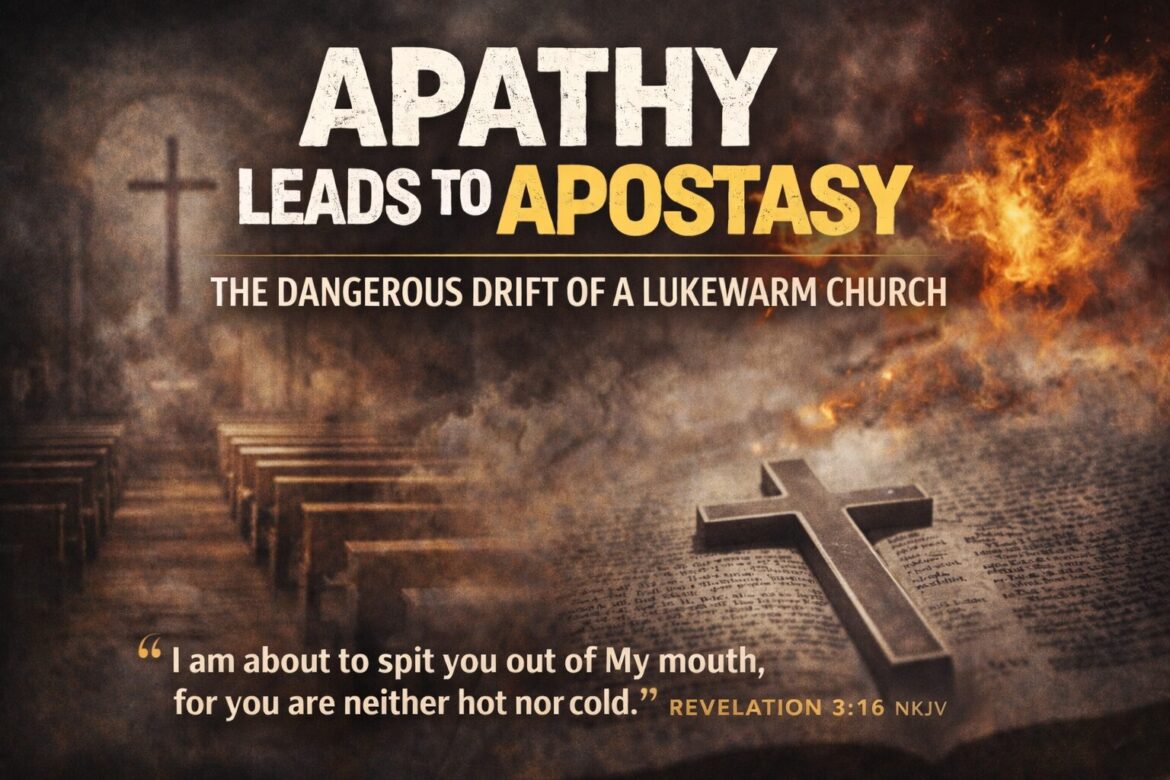
Apathy is not a small matter. It is not merely spiritual tiredness or simply a bad week. It is a dangerous cooling of the soul toward God, a dullness of heart, a loss of spiritual appetite, and the gradual acceptance of a Christianity that keeps Christ’s name while surrendering the passion, obedience, holiness, and devotion that belong to Him. When apathy is tolerated, apostasy is never far behind.
The church must take this issue seriously. Apostasy rarely arrives without warning—most often preceded by spiritual laziness, compromise, worldliness, neglect of truth, and the withering of the Holy Spirit’s fruits. Public falls are preceded by inward drifting, private neglect, and devotional abandonment.
We live in serious times. Many professing Christians grow casual about sin, doctrine, prayer, and the substance of faith. Some still attend church and use Christian language but show little evidence of fervency, repentance, or the fruit of the Spirit. This is not harmless immaturity but a warning sign.
Jesus Christ Himself warned the church against lukewarmness. His words to Laodicea are among the most searching and sobering in all of Scripture: “I know your works, that you are neither cold nor hot. I could wish you were cold or hot. So then, because you are lukewarm, and neither cold nor hot, I will vomit you out of My mouth” (Revelation 3:15–16, NKJV). This is not the language of mild concern. It is the language of divine disgust. Lukewarm religion is revolting to the risen Christ.
These words should shake the church awake. Jesus does not commend indifference. He does not celebrate nominal faith. He does not bless a Christianity that speaks His name while refusing His lordship. He does not accept a divided heart. He does not applaud believers who try to stand with one foot in the kingdom and one foot in the world. He calls His people to zeal, repentance, faithfulness, and wholehearted devotion.
The danger before us is clear: apathy is the prelude to apostasy. When believers neglect their walk with Christ, spiritual defenses weaken. As prayer, meditation, and pursuit of holiness fade, the fruits of the Spirit wither, and the works of the flesh rise. Sustained worldliness, tolerated sin, doctrinal negligence, and indifference create the conditions for departing from faith. Apathy is the breeding ground for apostasy.
What Is Apathy?
Spiritual apathy is a state of indifference toward the things of God. It is a condition in which the soul no longer burns for Christ, trembles at His Word, loves holiness, hates sin, and longs for communion with the Lord. The apathetic believer may still participate outwardly in Christian activities, but inwardly there is a drift toward deadness and decline. Prayer becomes mechanical. Worship becomes formal. Scripture becomes neglected. Repentance becomes rare. The fear of the Lord fades. Conviction weakens. Sin becomes easier to tolerate. The world no longer appears dangerous. Christ no longer appears precious.
This condition is dangerous because it deceives. A person may feel safe comparing himself to obviously wicked people, or pointing to attendance, Christian language, or past experiences. Yet possessing religious language is not the point; the question is whether the heart is alive to God.
The Lord spoke through the prophet Amos about a complacent people who were at ease when they should have been alarmed: “Woe to you who are at ease in Zion” (Amos 6:1, NKJV). That warning still speaks. Ease in Zion is dangerous when holiness is neglected, and spiritual urgency is gone. It is possible to feel secure in a condition that God condemns.
Apathy appears when believers stop fighting sin seriously. They excuse what they once confessed, laugh at what once grieved them, consume what corrupts, pursue pride, and indulge the soul’s weakness. Grace, to them, becomes a cover for compromise instead of a power for holiness. This is not liberty of the Spirit; it is the dullness of drift.
How Apathy Opens the Door to Apostasy
Apostasy is not merely stumbling into sin. It is a falling away from the faith, a departure from truth, a turning from Christ. Scripture warns repeatedly that in the last days, many will depart, deceive, and be deceived. Paul wrote plainly: “Now the Spirit expressly says that in latter times some will depart from the faith, giving heed to deceiving spirits and doctrines of demons” (1 Timothy 4:1, NKJV). Notice that the departure does not happen in a vacuum. It comes as people give attention to the wrong voices. The heart that no longer clings closely to God becomes vulnerable to lies.
Apathy weakens discernment. Without feeding on truth, praying, or walking in the Spirit, believers become easier prey for error, temptation, and seduction. The devil welcomes spiritual drowsiness, starting with inward neglect rather than public renunciation.
Hebrews gives solemn warnings about drifting. “Therefore, we must give the more earnest heed to the things we have heard, lest we drift away” (Hebrews 2:1, NKJV). Drifting is subtle. It is usually unintentional. It happens when vigilance ceases. A ship does not need to choose the rocks consciously; it only needs to stop actively holding its course. So it is spiritually. Men do not always wake up one day and decide to deny Christ. They drift through neglected devotion, unjudged sin, worldly compromise, ignored truth, and repeated resistance to conviction.
Hebrews also says, “Beware, brethren, lest there be in any of you an evil heart of unbelief in departing from the living God” (Hebrews 3:12, NKJV). The warning is addressed to brethren because the danger is real in the visible community of faith. Departure from God is not only a dramatic event at the end of a process. It begins as unbelief takes root in the heart. Apathy nourishes that unbelief by starving the soul of truth, prayer, worship, and obedience.
Then comes hardness. “But exhort one another daily, while it is called ‘Today,’ lest any of you be hardened through the deceitfulness of sin” (Hebrews 3:13, NKJV). Sin deceives. It promises pleasure and conceals poison. It whispers that compromise is harmless, that prayer can wait, that repentance can be postponed, that holiness is extreme, and that zeal is unnecessary. Through repeated indulgence, the heart hardens. What once pierced the conscience no longer troubles it. That is the soil in which apostasy grows.
The Marks of a Lukewarm Christianity
The church at Laodicea is a fearful picture of lukewarm religion. They were not commended for fervent love, steadfast endurance, or sound devotion. Instead, they were exposed for self-deception. Jesus said, “Because you say, ‘I am rich, have become wealthy, and have need of nothing’—and do not know that you are wretched, miserable, poor, blind, and naked” (Revelation 3:17, NKJV). Lukewarm Christianity often comes with a false sense of spiritual sufficiency. People think they are well because they are active, informed, prosperous, or outwardly respectable. But Christ sees beyond appearances.
A lukewarm Christianity exhibits several clear features.
First, lukewarm Christianity lacks spiritual intensity: no burning love for Christ, urgency in prayer, deep hunger for holiness, or strong grief over sin. Everything becomes moderate and casual.
Second, it tolerates a mixture. The lukewarm Christian wants enough of Christ to feel safe, but enough of the world to feel comfortable. He does not want to be too radical, too separated, too obedient, too serious, or too heavenly-minded. He prefers a safe and socially acceptable religion.
Third, it rests in appearance. Because outward forms may still remain, the lukewarm soul imagines that inward decline is unimportant. Yet God looks on the heart. Leaves without fruit do not satisfy Him.
Fourth, it resists correction. When zeal is gone, rebuke feels offensive rather than loving. Yet Jesus said, “As many as I love, I rebuke and chasten. Therefore be zealous and repent” (Revelation 3:19, NKJV). Love rebukes. Christ wounds to heal. He exposes the lukewarm not to destroy them, but to summon them to repentance.
Fifth, lukewarm Christianity is often rich in profession and poor in fruit. It may know songs, sermons, conferences, terminology, and religious culture, yet lack power, purity, humility, prayerfulness, and godly love.
When the Fruits of the Spirit Are Missing
One of the clearest signs of spiritual decline is the absence of the fruit of the Holy Spirit. Paul writes, “But the fruit of the Spirit is love, joy, peace, longsuffering, kindness, goodness, faithfulness, gentleness, self-control” (Galatians 5:22–23, NKJV). These are not optional decorations in the Christian life. They are evidence of the Spirit’s sanctifying work. Where the Spirit rules, fruit appears. Not sinless perfection, but real transformation. Not empty talk, but visible grace.
When love is absent, something is wrong. The believer who grows cold toward God will soon grow cold toward people. The first and great commandment is to love the Lord with all the heart, soul, mind, and strength. When that love fades, duty becomes drudgery and worship becomes hollow.
When joy is absent, the soul often seeks substitutes. Instead of delighting in God, the apathetic believer begins to look to entertainment, pleasure, worldly approval, and fleshly indulgence for satisfaction. Yet none of these can restore what only communion with Christ can give.
When peace is absent, anxiety and restlessness often multiply. This can drive people deeper into worldly distractions instead of deeper into prayer. “Be anxious for nothing, but in everything by prayer and supplication, with thanksgiving, let your requests be made known to God” (Philippians 4:6, NKJV). A neglected prayer life leaves the soul exposed.
When long-suffering, kindness, goodness, gentleness, and self-control are absent, the works of the flesh begin to rise. Paul sets these in contrast: “Now the works of the flesh are evident, which are: adultery, fornication, uncleanness, lewdness, idolatry, sorcery, hatred, contentions, jealousies, outbursts of wrath, selfish ambitions, dissensions, heresies, envy, murders, drunkenness, revelries, and the like” (Galatians 5:19–21, NKJV). The absence of spiritual fruit is never morally neutral. Where the Spirit is not being yielded to, the flesh begins to manifest itself.
This is why apathy is so dangerous. It is not simply the absence of zeal. It is the condition in which spiritual fruit withers and fleshly corruption spreads. A lukewarm Christian life creates room for impurity, pride, envy, worldliness, selfishness, and compromise. Eventually, where the flesh rules and Christ is persistently resisted, apostasy becomes more conceivable.
Friendship with the World Is Enmity with God
One of the most common pathways from apathy to apostasy is worldliness. James does not speak gently here: “Adulterers and adulteresses! Do you not know that friendship with the world is enmity with God? Whoever therefore wants to be a friend of the world makes himself an enemy of God” (James 4:4, NKJV). The world in this sense is the rebellious order of life organized against God—its lusts, prides, values, and desires.
Many believers do not fall away because persecution drove them out. They fall away because the world drew them in. Demas is the classic example: “For Demas has forsaken me, having loved this present world” (2 Timothy 4:10, NKJV). He did not merely lose interest in ministry logistics. He loved this present world. That is what pulled him away.
Worldliness does not always look scandalous at first. It may begin as a fascination with status, an obsession with money, an addiction to comfort, a hunger for human praise, a love of entertainment, a compromise in relationships, or a gradual acceptance of the world’s moral standards. But wherever the world is embraced, affection for Christ diminishes. John warns with clarity: “Do not love the world or the things in the world. If anyone loves the world, the love of the Father is not in him” (1 John 2:15, NKJV).
This does not mean believers have no struggles or temptations. It means that a settled love for the world is incompatible with true devotion to God. Apathy lowers resistance to the world. The believer stops guarding the heart, stops examining influences, stops rejecting corrupt companionships, and stops mortifying sinful desires. In time, the mind is shaped by the world rather than renewed by the Word.
Paul exhorts, “And do not be conformed to this world, but be transformed by the renewing of your mind” (Romans 12:2, NKJV). Conformity is easy when apathy reigns. Transformation requires active yielding to God. If the church ceases to resist worldly patterns, it will not remain neutral. It will be confirmed.
Neglect of the Means of Grace
Apathy often expresses itself through neglect of the means God has appointed for spiritual strength. Prayer is neglected. Scripture is neglected. Fellowship is neglected. Self-examination is neglected. Worship is neglected. The Lord’s Supper is treated lightly. Gathering with the saints becomes optional. Evangelism is forgotten. Obedience is delayed.
But God has not left His people without provision. The Word of God is not an accessory; it is life to the soul. Jesus said, “Man shall not live by bread alone, but by every word that proceeds from the mouth of God” (Matthew 4:4, NKJV). To neglect Scripture is to starve spiritually. A starved soul is easily weakened.
Prayer is likewise indispensable. Jesus told His disciples, “Watch and pray, lest you enter into temptation. The spirit indeed is willing, but the flesh is weak” (Matthew 26:41, NKJV). The issue is not whether temptation will come, but whether believers are prepared to meet it. Prayerlessness is practical self-confidence, and self-confidence precedes collapse.
The assembly of believers is also vital. Hebrews 10:25 warns against “not forsaking the assembling of ourselves together, as is the manner of some, but exhorting one another” (NKJV). Isolation aids drift. God uses the body to strengthen, rebuke, encourage, and preserve His people. The apathetic soul often withdraws from serious fellowship because light exposes decline.
Self-examination is another neglected grace. Paul writes, “Examine yourselves as to whether you are in the faith. Test yourselves” (2 Corinthians 13:5, NKJV). This is not morbid introspection but sober spiritual honesty. Apathy hates examinations because they reveal reality.
Apostasy in the Last Days
Scripture repeatedly warns that the last days will be marked by departure from truth and moral decline. Jesus said, “And because lawlessness will abound, the love of many will grow cold” (Matthew 24:12, NKJV). Notice again the connection between increasing sin and decreasing love. Lawlessness not only affects culture; it also affects the church when left unresisted. The atmosphere of sin cools many hearts.
Paul describes perilous times in 2 Timothy 3:1–5, speaking of men who are lovers of themselves, lovers of money, proud, blasphemers, unholy, unloving, without self-control, lovers of pleasure rather than lovers of God, “having a form of godliness but denying its power” (NKJV). That final phrase is crucial. A form of godliness without power is the very picture of dead or lukewarm religion. It looks religious on the outside but lacks the transforming energy of the Holy Spirit.
Jesus also asked, “When the Son of Man comes, will He really find faith on the earth?” (Luke 18:8, NKJV). This does not imply the extinction of the true church, but it does indicate a solemn atmosphere of widespread spiritual weakness and scarcity of persevering faith. We should not be surprised, then, by increasing compromise and apostasy. We should be awakened by it.
The church must therefore reject the false comfort of outward profession without inward life. Not everyone who names Christ is walking with Christ. Not all growth is spiritual growth. Not all activity is holiness. Not all influence is faithfulness. The test is not appearance, but perseverance in truth, obedience, love, holiness, and fruitfulness by the Spirit.
Christ’s Call to Repentance
The good news is that Christ does not merely expose; He also calls. To Laodicea, after His severe warning, He says, “Be zealous and repent” (Revelation 3:19, NKJV). There is still a door of mercy. There is still a summons to return. There is still hope for the lukewarm if they will hear His voice.
Christ also says, “Behold, I stand at the door and knock” (Revelation 3:20, NKJV). Though often used evangelistically, in context, it is a word to a church that has excluded her Lord functionally through complacency and self-sufficiency. What a tragedy when Christ stands outside a church that bears His name. Yet what mercy that He still knocks.
Repentance is not mere emotion. It is a turning. It is a change of mind that produces a change of direction. It involves confession of sin, renunciation of compromise, renewed obedience, restoration of prayer, return to the Word, separation from worldliness, and a fresh pursuit of Christ. Genuine repentance is urgent because the danger is urgent.
James gives a strong call: “Draw near to God, and He will draw near to you. Cleanse your hands, you sinners; and purify your hearts, you double-minded” (James 4:8, NKJV). That is the need of the hour. Double-minded Christianity must end. Half-hearted religion must end. Divided loyalties must end. The church must draw near to God again.
How Believers Must Guard Against Apathy
First, believers must abide in Christ. Jesus said, “Abide in Me, and I in you… for without Me you can do nothing” (John 15:4–5, NKJV). Fruitlessness comes from disconnection. Spiritual vitality is not maintained by mere resolve, but by ongoing communion with Christ.
Second, believers must keep short accounts with God. Sin must be confessed quickly and honestly. “If we confess our sins, He is faithful and just to forgive us our sins and to cleanse us from all unrighteousness” (1 John 1:9, NKJV). Hidden sin nourishes apathy. Confessed sin is brought into the light.
Third, believers must feed deeply on Scripture. “Your word I have hidden in my heart, that I might not sin against You” (Psalm 119:11, NKJV). The Word instructs, convicts, strengthens, warns, and revives.
Fourth, believers must pray fervently. “Continue earnestly in prayer, being vigilant in it with thanksgiving” (Colossians 4:2, NKJV). Vigilance and prayer belong together. A sleepy church will be a compromised church.
Fifth, believers must walk in the Spirit. “Walk in the Spirit, and you shall not fulfill the lust of the flesh” (Galatians 5:16, NKJV). Victory over the flesh is not secured through self-effort alone, but through Spirit-enabled obedience.
Sixth, believers must cultivate the fear of the Lord. “By the fear of the Lord one departs from evil” (Proverbs 16:6, NKJV). Casual views of God produce casual views of sin.
Seventh, believers must love Christ above all. The issue is not merely discipline but affection. A soul in love with Christ has a stronger defense against the seductions of the world. Where love for Jesus burns brightly, the charms of sin lose some of their power.
A Final Warning to the Church
The church must not normalize lukewarmness. We must not rename apathy as balance, compromise as wisdom, worldliness as relevance, or fruitlessness as weakness. If believers neglect Christ, if they cease to walk in the Spirit, if they love the world, if they no longer bear spiritual fruit, if they persist in indifference and refuse repentance, then apathy will ripen into deeper ruin. Scripture does not speak these warnings in vain.
Jesus said, “Remember therefore from where you have fallen; repent and do the first works” (Revelation 2:5, NKJV). The answer is not novelty, trendiness, or outward reinvention. The answer is repentance and return. Return to first love. Return to prayer. Return to holiness. Return to the Word. Return to the fear of the Lord. Return to wholehearted obedience.
The times in which we live demand seriousness. The church cannot afford sleepy religion in a darkening age. We cannot afford biblical illiteracy while deception multiplies. We cannot afford to compromise while lawlessness abounds. We cannot afford lukewarmness when Christ is worthy of all. He did not shed His blood for a half-hearted bride. He deserves a holy, watchful, praying, faithful people.
Let every believer ask before God: Am I drifting? Am I lukewarm? Have I neglected prayer? Have I tolerated sin? Have I loved the world? Are the fruits of the Spirit evident in my life? Is Christ truly first? These are not comfortable questions, but they are necessary questions.
And let every church ask: Are we rich in appearance but poor in power? Are we active but prayerless? Crowded but unholy? Busy but fruitless? Informed but unbroken? If so, the answer is not denial. The answer is repentance.
May the Lord awaken His church before apathy hardens into apostasy. May He restore holy fear where there is casualness, zeal where there is lukewarmness, truth where there is confusion, holiness where there is compromise, and love for Christ where the world has stolen the heart. And may the people of God hear again the voice of the Savior: “He who has an ear, let him hear what the Spirit says to the churches” (Revelation 3:22, NKJV).
Prayer
Lord Jesus Christ, awaken Your church. Deliver us from spiritual laziness, worldly compromise, and lukewarm religion. Restore to us a burning love for Your name, a hunger for Your Word, a faithfulness in prayer, and the manifest fruit of the Holy Spirit in our lives. Keep us from drifting, hardening, and falling away. Grant us repentance where we have grown cold, courage where we have become passive, and holiness in an age of corruption. Make Your people watchful, steadfast, and full of truth until You come. In Jesus’ name, amen.