By Evangelist Peter Gee, Editor-in-Chief, Christianity News Daily.
03/30/2026
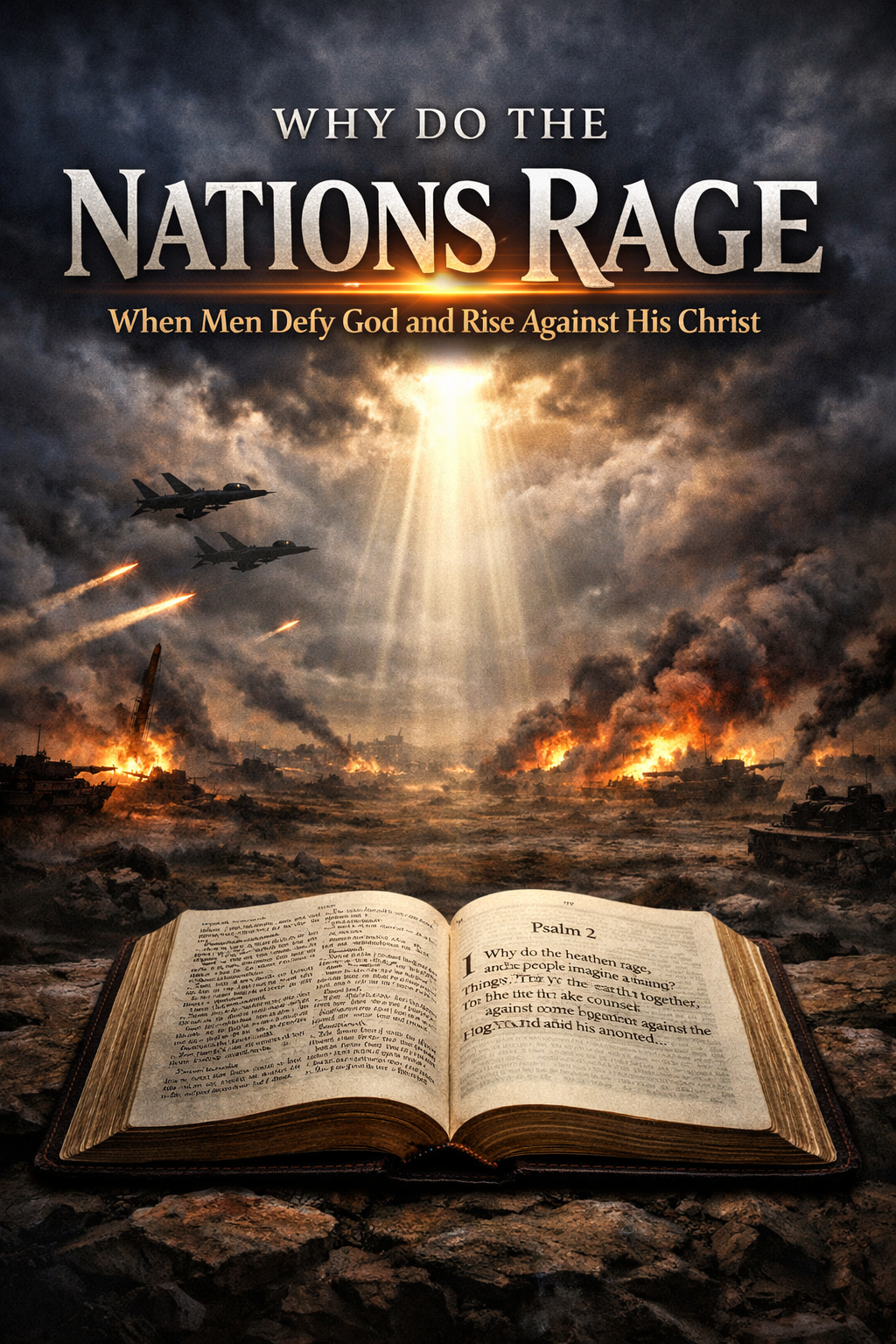
The world is once again watching nations rise in anger, rulers make bold calculations, alliances harden, and military conflict intensifies. In every generation, men convince themselves that power can settle what the human heart has broken. They believe strategy can overcome truth, force can secure peace, and the will of rulers can reorder the world without reference to God. But long before the age of missiles, drones, submarines, satellites, bombers, aircraft carriers, and battle groups, the Spirit of God had already asked the question that still exposes the madness of history: Why do the nations rage?
This question comes from Psalm 2, a powerful royal and prophetic psalm. It offers not only a poetic observation on political unrest but also a divine diagnosis of organized human rebellion against God. The nations rage, refusing God’s rule; the people imagine freedom through casting off divine authority, believing they can still prosper. Kings set themselves, convinced that thrones, armies, and political power can outlast the decree of heaven.
Yet, Psalm 2 answers this arrogance with breathtaking simplicity. God is not threatened by the rage of nations. He is not alarmed by their coalitions, nor is He pacing the courts of heaven in uncertainty. Instead, He sits enthroned and witnesses the uproar of rulers and the pride of empires. He hears the threats of men, the boasting of kings. Amid all this earthly noise, He declares: His King is already appointed. His Christ, already enthroned. His purpose, already fixed. The rage of the nations? Real. But it is also vain.
This is why Psalm 2 is so urgent for the church in times of war. It reminds us that history is not random, that conflict is not merely political, and that rebellion against God lies beneath the rage of the world. It also reminds us that Jesus Christ is not merely a figure of private devotion. He is the anointed King of God, the ruler whom the nations reject and the Son to whom every ruler must ultimately answer.
The Ancient Question That Still Exposes the Modern World
Psalm 2 opens with words that feel as though they were written for every century at once
Why do the nations rage and the people imagine a vain thing
The kings of the earth set themselves, and the rulers take counsel together against the Lord and against his anointed
Psalm 2:1 to 2
The psalm begins not with military detail but with moral astonishment: Why do they rage? Why this uproar, this frenzy, this proud and restless agitation among the nations? Why this plotting and scheming, this confidence in plans destined to fail?
The rage of the nations is not presented as wisdom. It is not noble. It is not enlightened. It is not peace-seeking. It is rebellion. The nations are in tumult because the human heart is in revolt against God. The rulers take counsel together because man in his pride prefers united rebellion to humble submission. The people imagine a vain thing because fallen humanity repeatedly believes that it can overthrow divine authority, redefine righteousness, and rule without reference to heaven.
Psalm 2 goes further. The rebellion is not merely against moral order in general. It is specifically against the Lord and against His anointed. The target is God and His Christ. That is why the issue is deeper than politics. Nations may say they are pursuing security, justice, liberation, progress, democracy, sovereignty, survival, or historical necessity. But when rulers refuse God’s authority and reject His Christ, their conflict becomes part of a larger spiritual rebellion that spans the ages.
Verse 3 reveals the heart of this defiance.
Let us break their bands asunder and cast away their cords from us.
This is the language of sinful man, interpreting God’s rule as bondage. Fallen humanity does not naturally see the commandments of God as life. It sees them as restrictions. It does not see Christ as the rightful King. It sees Him as an obstacle to autonomy. It does not see holiness as beauty. It sees holiness as interference. So the nations rage because they want freedom from God rather than freedom in God.
That is the old lie of Eden rising again in national and political form.
The Same Rebellion With New Weapons
Modern warfare looks different from ancient warfare, but its heart remains unchanged. Ancient kings relied on chariots, horses, shields, spears, bows, and swords; today, nations deploy drones, missiles, aircraft, fleets, submarines, armored divisions, cyber capabilities, surveillance, and precision-strike systems. The instruments have changed, but the rebellion has not.
The Bible teaches that beneath the noise of war, there is always something deeper than hardware or logistics. James asks
From whence come wars and fightings among you? Come they not hence, even of your lusts that war in your members
James 4 1
External conflict reveals internal struggle; the battlefield exposes the heart. Pride, fear, ambition, vengeance, greed, domination, rebellion, and unbelief produce the conflicts of men and nations. That is why Psalm 2 remains permanently relevant—it is not limited to one empire or region, but is the recurring story of mankind’s refusal to submit to God’s rule.
The world often imagines that a new form of government, a new coalition, a new military doctrine, or a new international framework can finally cure the human condition. But Scripture says the human problem is sin. No weapon system can fix that. No alliance can redeem the heart. No regime change can regenerate man. No political order can replace the need for repentance before God.
That is why the nations continue to rage. The technologies evolve, but the soul of rebellion remains untouched apart from the grace of God.
David the Warrior Who Understood the Madness of Nations
It is striking that Psalm 2 stands in the Psalms. These are the songs of Israel, within the orbit of Davidic kingship. David was not sheltered from war. He knew battlefields. He knew pursuit. He knew siege, violence, military threat, and the rise and fall of enemies. He fought Goliath. He fled from Saul. He battled the Philistines. He established the kingdom through years of hardship and conflict.
David was a warrior, yet he asked a theological question about war. He did not merely analyze enemy movements. He asked why nations rage at all. This is what sets biblical revelation apart from worldly commentary. The Bible does not stop at the surface. It searches the human heart. It places every conflict beneath the rule of God.
David understood that no king is saved by the multitude of an host and no mighty man is delivered by much strength. He knew that some trusted in chariots and some in horses, but the people of God must remember the name of the Lord. He knew the Lord teaches hands to war, yet he also knew victory belongs to God. David’s perspective was therefore never merely tactical. It was covenantal. It was theological. It was doxological.
That is why Psalm 2 sounds so majestic. David knew what armies could do, but he also knew what they could never do. They could never dethrone God.
Old Testament Examples of the Nations Raging Against God
The Old Testament gives example after example of nations raging, rulers boasting, and human power colliding with divine sovereignty.
Pharaoh and Egypt
Pharaoh stands as one of the clearest pictures of defiant rulership in all Scripture. In Exodus 1 to 14, he oppressed the people of God, ordered the killing of Hebrew sons, hardened his heart against the word of the Lord, and imagined that royal will could resist divine command. Again and again, God sent warnings, signs, and judgment. Again and again, Pharaoh refused. His armies pursued Israel into the path of the Red Sea, certain of victory. But the Lord overthrew them, proving that imperial power is nothing before the God of heaven.
Amalek
In Exodus 17, Amalek attacked Israel in hostility and cruelty. This aggression was remembered by God. Amalek became a symbol of opposition to the covenant people and, by extension, to the Lord Himself. Human violence may seem opportunistic and momentary, but God records it and judges it.
Jericho and the Kings of Canaan
When Israel entered the land, the kings of Canaan gathered in resistance. Some fortified cities. Others formed coalitions. In Joshua 10 and 11, multiple kings united against the advance of the people of God. But their confederacies could not overturn what God had decreed. Jericho fell, not because Israel mastered siegecraft, but because God spoke and acted. The lesson is plain. When rulers oppose the purposes of God, no amount of organization can save them.
The Philistines and Goliath
The Philistines are among the most repeated enemies in Israel’s history. Their challenge reached a dramatic height in 1 Samuel 17, where Goliath defied the armies of the living God. This was not merely a military insult. It was blasphemous arrogance. Goliath trusted in armor, weapons, size, and intimidation. David trusted in the name of the Lord. The giant fell because the battle belonged to God.
The Midianites
In Judges 7, God deliberately reduced Gideon’s army so that Israel would not boast in human strength. He would not allow His people to think salvation came through numbers or military superiority. The Midianites fell, and the glory belonged to the Lord alone.
The Syrians
In 2 Kings 6 and 7, the Syrians became another example of military pressure and divine reversal. God repeatedly exposed their plans, delivered His people, and even caused panic in the enemy camp so that they fled at the sound. What armies interpret as certainty can be undone by a word from God.
Assyria
Assyria rose as a terrifying world power. It conquered broadly, boasted loudly, and mocked openly. In 2 Kings 18 and 19 and Isaiah 10, Assyria becomes the very image of imperial arrogance. Sennacherib and his representatives treated the God of Israel as though He were one more local deity unable to withstand Assyrian force. Yet in a single night, the angel of the Lord struck the camp, and the proud invader was brought low. Assyria raged, but heaven ruled.
Babylon
Babylon was used by God as an instrument of judgment against Judah, yet Babylon itself became drunk with pride. Nebuchadnezzar gloried in his own greatness in Daniel 4, only to be humbled until he learned that the Most High rules in the kingdom of men. Belshazzar later blasphemed openly in Daniel 5, using the vessels of the temple in arrogance, and judgment fell that very night. Even when God uses nations for His purposes, those nations are not exempt from His judgment.
Israel’s Own Wars and the Danger of Presumption
The Bible does not flatter Israel either. The Old Testament makes clear that not every battle involving God’s people was automatically righteous simply because Israel was involved. When Achan sinned and Israel presumed upon victory, they were defeated at Ai in Joshua 7. When Saul disobeyed God regarding Amalek in 1 Samuel 15, he was rejected by God. When David numbered the people in pride in 2 Samuel 24, judgment came. When the kings of Israel and Judah turned to idolatry, foreign invasion became an instrument of covenant discipline.
This is important because Psalm 2 must never be used as a simplistic slogan to justify any nation’s ambitions. The point of the psalm is not that one earthly state can do no wrong. The point is that all nations stand under God’s rule, and all rulers are accountable to His Christ. No leader is beyond judgment. No military action escapes His notice. No throne can claim moral innocence merely because it is powerful.
Acts 4 and the Ultimate Fulfillment of Psalm 2
The New Testament makes the meaning of Psalm 2 even clearer. In Acts 4, after the apostles were threatened, the believers lifted their voices to God and quoted Psalm 2. They identified the raging of the nations and the plotting of rulers with the conspiracy against Jesus Christ. Herod, Pontius Pilate, the Gentiles, and the people of Israel had gathered together against God’s holy child, Jesus.
This is one of the most important interpretive keys in all Scripture. It shows that Psalm 2 is not just about war in the abstract. It reaches its fullest expression in the world’s rejection of Christ. Political power, religious power, legal power, and mob sentiment all converged against the Son of God. The nations raged. The people imagined a vain thing. The rulers took counsel together.
And yet even there their rebellion was vain.
They crucified Christ, but they did not defeat Him. They carried out what God had already determined in His redemptive purpose. The cross was not the triumph of rebellious nations over the Messiah. It was the means by which the Messiah triumphed over sin, death, and hell. Their rage served the purpose they could not overthrow.
This means Psalm 2 is not merely a psalm of warning. It is also a psalm of Christ. The Anointed One is Jesus. The Son is Jesus. The King set upon Zion is Jesus. The One the rulers reject is Jesus. The One to whom the nations belong is Jesus.
God’s Reaction to the Rage of Men
Psalm 2 gives one of the most sobering answers in Scripture.
He that sitteth in the heavens shall laugh, the Lord shall have them in derision.
This is not divine amusement in suffering. It is divine contempt for arrogant rebellion. God is not intimidated by the rage of men. He is not destabilized by military escalation or imperial ambition. The nations rage, but He sits. That contrast is one of the great theological anchors of the psalm.
Men are agitated. God is enthroned.
Men are frantic. God is settled.
Men are temporary. God is eternal.
Men threaten. God decrees.
Then the Lord speaks.
Yet have I set my king upon my holy hill of Zion
This is the decisive answer to the rebellion of the world. God does not negotiate Christ’s kingship with the nations. He announces it. Jesus Christ is not a candidate seeking approval. He is the King appointed by God. He is not one option among many. He is the enthroned Son.
The nations may reject Him, but they cannot remove Him.
Rulers may blaspheme Him, but they cannot dethrone Him.
Empires may resist Him, but they cannot escape Him.
The Son Who Will Rule the Nations
Psalm 2 continues with the decree of God concerning His Son. The New Testament repeatedly applies this royal and messianic language to Christ. He is the promised King, the Son of God, the heir of the nations, and the ruler who will judge all rebellion.
The psalm says that the nations are His inheritance and the uttermost parts of the earth His possession. That means the nations do not belong ultimately to presidents, parliaments, kings, oligarchs, generals, parties, or revolutions. They belong to Christ. The world is His by right.
It also says He will rule with a rod of iron. This corrects sentimental distortions of Jesus. The same Christ who came in humility the first time will come in power and judgment. The meek Lamb is also the royal Son. The Savior is also the Judge. The King rejected by the world will one day openly reign over it.
That is why the nations’ rebellion is so tragic. Men rage against the very One who alone can save them.
Why Human Plans Are Always Vain Without God
Psalm 2 says the peoples imagine a vain thing. That word vain is devastating. It means empty, futile, weightless, without lasting substance. Human plans may appear sophisticated, but when they defy God, they are emptiness dressed in confidence.
This has been proven repeatedly in Scripture.
Pharaoh imagined he could hold Israel. He could not.
Goliath imagined he could humiliate the people of God. He could not.
Sennacherib imagined he could terrify Judah and mock the Lord. He could not.
Nebuchadnezzar imagined his majesty was self-made. It was not.
Herod and Pilate imagined they could dispose of Jesus. They could not.
Human rebellion can wound, devastate, destroy, and kill. The Bible does not minimize its horrors. But it does insist that rebellion cannot ultimately win. It cannot overturn God’s decree. It cannot cancel God’s Christ. It cannot stop the kingdom of God.
This is why the church must never interpret temporary human success as ultimate victory. The nations rage loudly, but their noise does not alter the throne of heaven.
What Psalm 2 Says to the Modern World
Psalm 2 still speaks with thunderous relevance.
It tells nations that their unrest is not merely geopolitical but moral and spiritual.
It tells rulers that power does not free them from accountability.
It tells armies that strength is not sovereignty.
It tells societies that freedom without God becomes rebellion.
It tells the church that Christ remains enthroned.
It tells every sinner that refuge still exists in the Son.
The psalm also warns against the idolatry of political salvation. Men repeatedly believe that a new system, a new power arrangement, a new alliance, or a new military doctrine can secure peace without repentance. But Scripture says there is no peace to the wicked. True peace is bound up with righteousness, and righteousness begins with submission to God.
The deepest crisis in the world is not merely instability among nations. It is rebellion against the Son.
The Church in a World of Raging Nations
How should believers respond when nations rage
The answer is not panic.
The answer is not propaganda.
The answer is not blind nationalism.
The answer is not despair.
In Acts 4, when the early church saw Psalm 2 fulfilled in the opposition to Christ and in the threats against the apostles, they prayed. They acknowledged God’s sovereignty. They asked for boldness. They kept preaching Jesus.
That remains the model.
The church should pray for mercy.
The church should mourn bloodshed.
The church should intercede for leaders.
The church should refuse lies.
The church should proclaim repentance.
The church should exalt Christ.
The church should remember that the kingdom of God is not shaken by the chaos of men.
Believers are called to see history through the throne, not the newsroom alone. Yes, we must be alert. Yes, we must be sober. Yes, we must care about suffering and truth. But we must never forget that Christ is Lord over the nations.
The Final Appeal of Psalm 2
Psalm 2 does not end merely with a warning. It ends with an appeal.
Be wise now, therefore, O ye kings, be instructed, ye judges of the earth
Serve the Lord with fear and rejoice with trembling
Kiss the Son lest he be angry and ye perish from the way
Blessed are all who put their trust in him
This is one of the most beautiful and urgent invitations in Scripture. Kings are warned, but they are also invited. Rulers are confronted, but they are also called to wisdom. The nations are not only told that they are wrong. They are told what they must do.
Serve the Lord.
Rejoice with trembling.
Kiss the Son.
Take refuge in Him.
The language is royal and covenantal. To kiss the Son is to submit to Him, honor Him, and acknowledge His rightful authority. It is the opposite of rage. It is the end of rebellion. It is the beginning of wisdom.
And this invitation is not only for rulers. It is for everyone. Blessed are all who put their trust in Him. In a world full of military pride, political upheaval, and violent uncertainty, there remains one safe refuge. Not a bunker. Not an army. Not a flag. Not a regime. The refuge is Jesus Christ.
Conclusion
Why do the nations rage
They rage because the human heart still resists God.
They rage because rulers still love power more than truth.
They rage because men still see divine authority as a chain rather than a gift.
They rage because rebellion remains the native instinct of fallen humanity.
But their rage is vain.
It was vain at Babel.
It was vain in Egypt.
It was vain before Jericho.
It was vain in the boasts of Goliath.
It was vain in Assyria.
It was vain in Babylon.
It was vain before the cross.
And it remains vain now.
The final answer to the rage of the nations is not found in military triumph or diplomatic brilliance. It is found in the decree of God and the person of His Son. Heaven has already spoken. God has already set His King upon His holy hill. Jesus Christ remains the Anointed One, the risen Son, the Lord of history, and the coming Judge of all the earth.
So let the church not tremble before the noise of men. Let the church fear God. Let the church preach Christ. Let the church pray with holy boldness. Let the church remember that every empire passes, every ruler falls, every proud plan fades, and every vain imagination perishes. But the kingdom of our God and of His Christ shall stand forever.
The nations rage.
The people imagine a vain thing.
The rulers take counsel together.
But the Son reigns.
And blessed are all they that put their trust in Him.
Closing prayer
Closing Prayer
O Lord God of heaven and earth
You who sit enthroned above the nations
We confess that man is proud, rebellious, and violent apart from Your mercy.
We see the rage of the people and the plotting of rulers
We see the sorrow, bloodshed, fear, and destruction that come when men reject Your authority
Teach us to fear You.
Teach us to trust Your word.
Teach us to look to Jesus Christ, Your Anointed King.
Give wisdom to rulers, repentance to nations, boldness to the church, and mercy to the suffering.
Restrain evil, expose lies, humble the proud, and turn many hearts to the Son.
May the kings of the earth be instructed
May the nations learn righteousness
May Your people stand firm in truth and hope
And may Jesus Christ be exalted above every throne, every army, every empire, and every name.
In the mighty name of Jesus Christ
Amen.