This is the central issue in Algeria. The state may have civil authority, but it does not have lordship over Christ’s church. No government has the authority to forbid believers from worshiping the Lord Jesus, gathering in His name, reading the Scriptures, praying together, baptizing disciples, and proclaiming the gospel. When earthly rulers command what God forbids, or forbid what God commands, Christians must obey God.
By Christianity News Daily Staff
04/27/2026
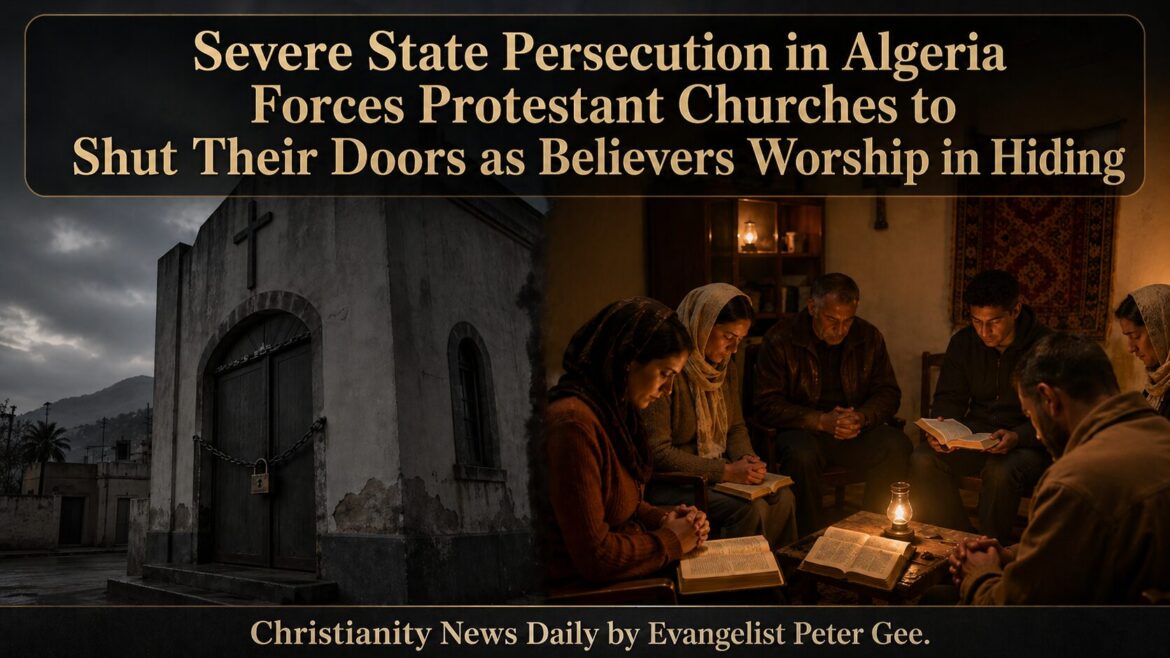
Severe state persecution in Algeria has forced Protestant churches to shut their doors, pushing believers into hidden worship as authorities continue tightening control over Christian gatherings.
Nearly all Protestant churches in Algeria have now been forced to close, driving thousands of Christians into private homes, informal gatherings, and underground fellowship, according to a recent report highlighted by Christian Daily International. The report says the closures are not random or isolated but part of a long-running legal and administrative campaign against non-Muslim worship in the country.
The situation is especially grave because Algeria’s Constitution formally recognizes freedom of conscience and worship, yet Christians on the ground are facing a completely unique reality. A 2026 report by the European Center for Law and Justice described the system facing Christians as a restrictive legal and administrative structure incompatible with international standards of religious freedom.
According to the ECLJ, the state has now closed 58 evangelical churches, forcing worshippers underground. The report identifies Algeria’s 2006 decree regulating non-Muslim worship and its 2012 law on associations as tools that control and restrict Christian life.
Open Doors has also reported that nearly every Protestant church in Algeria has been forced to close or suspend services, asking Christians worldwide to pray for believers who have lost their places of worship and for converts from Islam who face particular danger.
This is not merely a political or legal matter. It is a spiritual attack against the visible witness of the church of Jesus Christ.
The government may shut doors, seal buildings, restrict permits, and intimidate pastors. But the church of Jesus Christ is not built by permission of the state. It is built by the Lord Himself.
Jesus said:
“I will build My church, and the gates of Hades shall not prevail against it.”
— Matthew 16:18, NKJV
Algeria may close church buildings, but it cannot close the church Christ purchased with His blood.
A Campaign That Has Driven Protestant Worship Underground
For years, Algerian Protestant churches have faced increasing pressure through closures, denied permits, administrative barriers, and legal accusations. The burden has fallen especially on congregations connected to the Protestant Church of Algeria, often known by its French acronym, EPA.
Open Doors’ reporting on Algeria states that Protestant Christians are heavily targeted, with churches associated with the Evangelical Protestant Church either closed or forced to cease almost all meetings. Converts from Islam, who make up much of the Christian community, are especially vulnerable to pressure from family, society, and authorities.
Another Open Doors country report says state pressure on Protestant Christians in Algeria has intensified in recent years, with all 47 churches under the Evangelical Protestant Church of Algeria halting their activities and other independent churches also stopping meetings out of fear of government action.
International Christian Concern reported earlier this year that more than 40 Protestant churches had closed in less than a decade and that only one remained open at that time.
The newest reports suggest the situation has worsened still further. Christian Daily International reported that by January 2025, the last remaining evangelical churches had effectively ceased operations, leaving Christians to gather in private homes and informal settings.
This is how persecution often works. It does not always begin with prison doors. Occasionally, it begins with paperwork. Occasionally, it comes through licensing schemes, denied applications, inspection notices, sealed buildings, vague accusations, and administrative pressure that makes ordinary Christian worship legally impossible.
When the state says, “You may worship only with permission,” and then refuses to grant that permission, religious freedom becomes a dead letter.
The Pattern Is Familiar: First Control, Then Silence, Then Scatter
The pattern in Algeria resembles an old strategy used against the people of God: control the gathering, silence the preaching, intimidate the leaders, and scatter the believers.
But the New Testament shows that persecution never catches God by surprise.
In the book of Acts, the authorities commanded the apostles not to preach in the name of Jesus. The religious rulers wanted the message silenced because the gospel was spreading and the name of Christ was shaking the city.
Peter and John answered:
“Whether it is right in the sight of God to listen to you more than to God, you judge.
For we cannot but speak the things that we have seen and heard.”
— Acts 4:19–20, NKJV
Later, when the apostles were again commanded not to teach in the name of Jesus, they gave the answer that has guided the persecuted church for nearly two thousand years:
“We ought to obey God rather than men.”
— Acts 5:29, NKJV
This is the central issue in Algeria. The state may have civil authority, but it does not have lordship over Christ’s church. No government has the authority to forbid believers from worshiping the Lord Jesus, gathering in His name, reading the Scriptures, praying together, baptizing disciples, and proclaiming the gospel.
When earthly rulers command what God forbids, or forbid what God commands, Christians must obey God.
The Church Has Been Here Before
The Algerian church is not experiencing something foreign to Christianity. It is walking the same road the early church walked.
The first Christians did not inherit safety. They inherited a cross.
Jesus told His disciples plainly:
“If the world hates you, you know that it hated Me before it hated you.”
— John 15:18, NKJV
He also said:
“Remember the word that I said to you, ‘A servant is not greater than his master.’
If they persecuted Me, they will also persecute you.”
— John 15:20, NKJV
The persecution of the church is not accidental. It is the world’s hostility toward Christ expressed against those who belong to Him. The believer should not be surprised when the same world that rejected Jesus also resists His people.
The Apostle Paul later wrote:
“Yes, and all who desire to live godly in Christ Jesus will suffer persecution.”
— 2 Timothy 3:12, NKJV
This does not mean every Christian will suffer in the same way. Some suffer ridicule. Some suffer rejection. Some lose jobs. Some are imprisoned. Some are beaten. Some are killed. Some, like many Algerian Christians today, are forced out of public worship and into hidden fellowship.
But Scripture is clear: persecution is part of the cost of following Jesus Christ.
Stephen: The First Martyr and the Fire That Scattered the Church
One of the most important New Testament stories for understanding Algeria’s present moment is the martyrdom of Stephen.
Stephen was a man full of faith and the Holy Spirit. He preached Christ with boldness, exposed the hardness of those who resisted the Holy Spirit, and testified to the risen Lord. His hearers became enraged. They cast him out of the city and stoned him.
As he died, Stephen prayed:
“Lord Jesus, receive my spirit.”
— Acts 7:59, NKJV
Then he cried out:
“Lord, do not charge them with this sin.”
— Acts 7:60, NKJV
Stephen’s death did not end the church’s witness. It ignited a new stage of gospel expansion.
Immediately after Stephen was killed, Scripture says:
“At that time, a great persecution arose against the church which was at Jerusalem;
and they were all scattered throughout the regions of Judea and Samaria, except the apostles.”
— Acts 8:1, NKJV
The enemies of the church thought scattering believers would weaken the movement. But God used the scattering to spread the gospel.
Acts continues:
“Therefore, those who were scattered went everywhere preaching the word.”
— Acts 8:4, NKJV
This verse is critical for Algeria.
When persecution scattered the early Christians, they did not stop being the church. They carried the Word with them. They preached Christ wherever they went. They moved from temple courts and public spaces into roads, homes, villages, and new regions.
The same spiritual principle applies today. If Algerian Christians are pushed out of church buildings, they are not pushed out of Christ. If they are scattered into homes, they remain the church. If they meet quietly in private rooms, Christ is still present among them.
Jesus promised:
“For where two or three are gathered together in My name, I am there in the midst of them.”
— Matthew 18:20, NKJV
The government may close the building, but it cannot remove Christ from the gathering.
The Gospel Advances Even When the Church Is Pressured
The book of Acts shows that persecution often becomes the very road on which the gospel travels.
After the believers were scattered, Philip went down to Samaria and preached Christ there. The result was joy in the city.
“Then Philip went down to the city of Samaria and preached Christ to them.”
— Acts 8:5, NKJV
This truth is what persecutors never understand. The church is not dependent on comfort. The church is empowered by the Holy Spirit. The gospel does not require political favor to be true. It does not require cultural approval to save sinners. It does not require government permission to remain the power of God unto salvation.
Paul wrote:
“For I am not ashamed of the gospel of Christ, for it is the power of God to salvation for everyone who believes.”
— Romans 1:16, NKJV
Algeria’s Christians may now be forced into smaller, quieter, hidden gatherings. But the same gospel preached by the apostles remains alive. The same Christ who saved in Jerusalem, Samaria, Antioch, Philippi, Corinth, and Rome is able to save in Algeria.
The Word of God is not chained.
Paul wrote those very words while suffering imprisonment:
“For which I suffer trouble as an evildoer, even to the point of chains;
But the word of God is not chained.”
— 2 Timothy 2:9, NKJV
That verse must be remembered over Algeria. Church buildings may be chained. Doors may be locked. Pastors may be threatened. But the Word of God is not chained.
A Manufactured Legal Trap Against Christian Worship
The persecution in Algeria appears to operate through a legal contradiction.
Christians are told they must receive authorization to worship publicly. Yet reports indicate that the approval system has been used in a way that prevents churches from obtaining the permission required to function openly. Christian Daily International reported that Algeria’s legal system requires non-Muslim religious activity to take place in approved buildings, while religious associations must also register under state rules.
The ECLJ has argued that Algerian authorities have cracked down on “spiritual dissent” through repressive laws, citing the 2006 decree governing Christian worship and the 2012 law on associations.
This creates a trap: churches need approval to operate legally, but the approval is withheld or obstructed. Then, when believers gather without approval, they can be accused of unlawful religious activity.
That is not religious freedom. That is religious control.
The early church faced a similar attempt at control. The authorities did not merely dislike the apostles; they wanted to regulate the message. They wanted preaching in Jesus’ name to stop.
Acts 5 records that the apostles were arrested and imprisoned. But during the night, an angel of the Lord opened the prison doors and said:
“Go, stand in the temple and speak to the people all the words of this life.”
— Acts 5:20, NKJV
That command is powerful. God did not tell them to hide forever. He sent them back to proclaim the words of life.
In Algeria, wisdom may require caution. Believers may need to meet quietly. Pastors may need to protect their congregations. But the calling remains: Christ must be worshiped, the gospel must be preached, and the Word must be carried.
When Buildings Close, Homes Become Sanctuaries
The Algerian crackdown is forcing Christians into private homes and hidden fellowship. This is painful, but it is not unfamiliar to the New Testament church.
The earliest Christians often met in homes. The church was not born in cathedrals, basilicas, or state-approved institutions. It was born through the preaching of Christ, the power of the Holy Spirit, the breaking of bread, the apostles’ doctrine, prayer, and fellowship.
Acts 2 says:
“And they continued steadfastly in the apostles’ doctrine and fellowship,
in the breaking of bread, and in prayers.”
— Acts 2:42, NKJV
It also says:
“So continuing daily with one accord in the temple, and breaking bread from house to house,
They ate their food with gladness and simplicity of heart.”
— Acts 2:46, NKJV
House-to-house Christianity is not weak Christianity. It is apostolic Christianity.
When public worship is restricted, the home can become a sanctuary. A table can become a place of fellowship. A living room can become a prayer meeting. A small circle of believers can become a lampstand in the darkness.
This does not excuse Algeria’s suppression of churches. Christians should be free to worship publicly and peacefully. But it does remind us that the church has always been able to survive outside official structures.
Paul greeted churches that met in homes:
“Greet Priscilla and Aquila, my fellow workers in Christ Jesus…
Likewise, greet the church that is in their house.”
— Romans 16:3, 5, NKJV
The Algerian believers worshiping in homes today stand in a long line of faithful Christians who gathered under pressure, not because the world welcomed them, but because Christ was worthy.
Converts From Islam Face Special Pressure
Open Doors reports that converts from Islam in Algeria are particularly vulnerable because they can face opposition from family and community, as well as suspicion from authorities.
This matters deeply. Many Algerian Christians are not merely changing religious labels. They are confessing Jesus Christ in a social and spiritual context where leaving Islam can carry serious personal consequences.
Jesus warned that following Him could divide even households:
“Do not think that I came to bring peace on earth. I did not come to bring peace but a sword.
For I have come to ‘set a man against his father, a daughter against her mother,
and a daughter-in-law against her mother-in-law’.
and ‘a man’s enemies will be those of his own household.’”
— Matthew 10:34–36, NKJV
Those words are not a call to violence. They are a warning that loyalty to Christ may provoke rejection, even within one’s own family.
Jesus continued:
“He who loves father or mother more than Me is not worthy of Me.
And he who loves son or daughter more than Me is not worthy of Me.
And he who does not take his cross and follow after Me is not worthy of Me.”
— Matthew 10:37–38, NKJV
For converts in Algeria, these verses are not theoretical. They are lived realities. To confess Christ may mean suspicion, rejection, isolation, legal pressure, or loss of community. Yet the Lord Jesus is worthy of all.
The World May See Weakness, But Heaven Sees Faithfulness
To the world, an underground church may look weak. It lacks buildings. It lacks public visibility. It lacks institutional protection. It may not have signs, steeples, offices, or official recognition.
But heaven sees differently.
The Lord Jesus commended the suffering church in Smyrna:
“I know your works, tribulation, and poverty—but you are rich.”
— Revelation 2:9, NKJV
He then told them:
“Do not fear any of those things which you are about to suffer.
Indeed, the devil is about to throw some of you into prison so that you may be tested.
And you will have tribulation for ten days.
Be faithful until death, and I will give you the crown of life.”
— Revelation 2:10, NKJV
This is the message persecuted Christians need today. Christ sees. Christ knows. Christ remembers. Christ rewards.
Algerian believers may be ignored by much of the world, but they are not ignored by the Lord of the church. Their secret worship is not secret to Him. Their whispered prayers are heard in heaven. Their hidden gatherings are known by the Shepherd of their souls.
The Church Scattered Is Still the Church Sent
One of the most powerful truths in Acts is that the scattered church became the missionary church.
Persecution did not destroy the mission. It expanded it.
Acts 11 later describes believers scattered by persecution after Stephen’s death:
“Now those who were scattered after the persecution that arose over Stephen
traveled as far as Phoenicia, Cyprus, and Antioch, preaching the word…”
— Acts 11:19, NKJV
Then Scripture says some of them preached the Lord Jesus to the Hellenists, and
“The hand of the Lord was with them, and a great number believed and turned to the Lord.”
— Acts 11:21, NKJV
This is the mystery of God’s providence. What the enemy intends for suppression, God can use for multiplication.
The Algerian church has been pressured, scattered, and forced into hiding. But if believers remain faithful, prayerful, and rooted in Scripture, those hidden places can become seedbeds of gospel endurance.
Every home fellowship can become a witness. Every underground prayer meeting can become a place of spiritual strengthening. Every persecuted believer can carry the testimony of Jesus Christ into family, workplace, neighborhood, and community.
A Warning to Governments That Oppose Christ’s Church
Governments should understand that opposing the church of Jesus Christ is not a light matter.
The church does not belong to pastors, denominations, foreign organizations, or political movements. The church belongs to Christ.
Paul wrote:
“Christ also loved the church and gave Himself for her.”
— Ephesians 5:25, NKJV
When a state persecutes the church, it opposes those whom Christ purchased. When it shuts down worship, it interferes with obedience to God. When it criminalizes evangelism, it resists the command of the risen Lord.
The early persecutor Saul learned this personally. Before his conversion, he persecuted Christians intensely. Acts says he made havoc of the church, entering houses and dragging off men and women to prison.
“As for Saul, he made havoc of the church, entering every house,
and dragging off men and women, committing them to prison.”
— Acts 8:3, NKJV
But when the risen Christ appeared to him on the road to Damascus, Jesus did not say, “Why are you persecuting My followers?” He said:
“Saul, Saul, why are you persecuting Me?”
— Acts 9:4, NKJV
This is a fearful truth. To persecute Christ’s people is to persecute Christ Himself.
Every government, official, court, police authority, and local administrator should tremble before this reality. The Lord Jesus identifies with His suffering people.
The Responsibility of the Global Church
The suffering of Algeria’s Christians should not be ignored by the global church. When one part of the body suffers, the whole body should care.
Paul wrote:
“And if one member suffers, all the members suffer with it;
or if one member is honored, all the members rejoice with it.”
— 1 Corinthians 12:26, NKJV
This means believers in America, Europe, Africa, Asia, and the rest of the world should not treat Algeria’s underground church as distant news. These are brothers and sisters in Christ. Their struggle belongs to the whole household of faith.
The church should pray for them. Churches should speak about them. Christian media should report on them. Believers should advocate for religious freedom while remembering that the deepest need is spiritual endurance in Christ.
Hebrews says:
“Remember the prisoners as if chained with them —
those who are mistreated — since you yourselves are in the body also.”
— Hebrews 13:3, NKJV
Even when Algerian believers are not physically imprisoned, many are being pressured into a kind of religious confinement. Their churches are closed. Their meetings are restricted. Their public worship is suppressed. Their fellowship is forced into hiding.
They must be remembered.
Prayer Points for Algeria’s Persecuted Christians
Christians worldwide should pray urgently and specifically for Algeria.
Pray that the Lord will strengthen Protestant pastors whose churches have been closed.
Pray that believers forced into homes and hidden gatherings will remain faithful, joyful, and deeply rooted in Scripture.
Pray for converts from Islam who face pressure from family, community, and authorities.
Pray that Algeria’s government will allow churches to reopen and grant Christians the freedom to worship publicly and peacefully.
Pray that the gospel will spread through the very networks of underground fellowship that persecution has created.
Pray that fear will not silence the witness of Christ.
Pray that the Lord will raise up courageous leaders like Stephen, faithful witnesses like Peter and John, evangelists like Philip, and transformed servants like Paul.
Pray that Algeria will hear the gospel of Jesus Christ.
The Doors May Be Closed, But Christ Is Not Defeated
Algeria’s Protestant churches are facing severe state pressure. Many have been forced to shut their doors. Believers have been pushed into hidden worship. Pastors and congregations are navigating fear, uncertainty, and restriction.
But this is not the end of the story.
The church has been scattered before. The church has worshiped in homes before. The church has preached under threat before. The church has been commanded to be silent before. And every time, Christ has remained Lord.
When the apostles were beaten and commanded not to speak in the name of Jesus, they did not leave defeated. Scripture says:
“So they departed from the presence of the council,
rejoicing that they were counted worthy to suffer shame for His name.”
— Acts 5:41, NKJV
Then the next verse says:
“And daily in the temple, and in every house,
They did not cease teaching and preaching Jesus as the Christ.”
— Acts 5:42, NKJV
That is the pattern for the persecuted church.
In public, when possible.
In homes when necessary.
In suffering with joy.
In danger with courage.
In all things, preaching Jesus as the Christ.
Algeria’s government may shut the doors of the church, but it cannot shut the doors of heaven. It may push believers underground, but it cannot bury the gospel. It may restrict visible worship, but it cannot dethrone the risen Son of God.
The true church of Jesus Christ is not defeated by persecution. It is refined.
And the Word of God is not chained.