
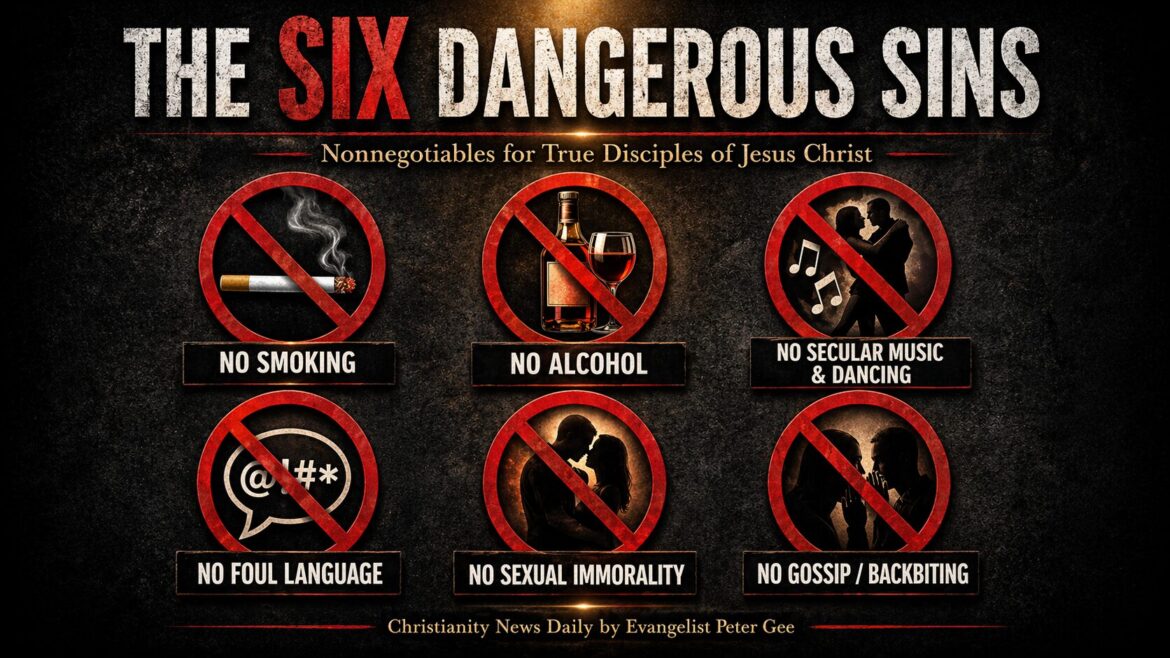
Smoking, Alcohol, Secular Music, Filthy Language, Sexual Immorality, and Gossip Must Not Rule the Life of a Believer.
By Evangelist Peter Gee, Editor in Chief, Christianity News Daily
04/24/2026
The modern church is facing a serious discipleship crisis.
Many attend church, participate in worship, and identify with Christianity, yet their daily actions often do not reflect true submission to Christ. Some seek the benefits of faith without embracing its responsibilities or personal transformation.
Jesus Christ calls individuals not just to admire Him but to follow Him.
He did not say, “Come and be entertained.” He said, “Follow Me.” He did not say, “Take up your preferences.” He said, “If any man will come after me, let him deny himself, and take up his cross daily, and follow me,” according to Luke 9:23.
That is discipleship.
Discipleship is not a slogan or event; it is a daily commitment to surrender one’s life to Jesus Christ. It involves living by the Spirit, rejecting compromise, and allowing God’s Word to guide every aspect of life.
The Lord Jesus warned that the path to life is narrow and that few people find it. Matthew 7:13–14 teaches that the broad way leads to destruction, while the narrow way leads to life. This is not popular preaching in a casual generation, but it is still the truth.
Believers should uphold clear biblical standards, emphasizing repentance, holiness, purity, sobriety, respectful speech, sexual discipline, and integrity. Grace does not excuse sin; it teaches us to reject ungodliness and worldly desires, as stated in Titus 2:11–12.
This article highlights six Christian nonnegotiables that should be taught in homes, youth ministries, discipleship classes, churches, and Christian families everywhere:
- No smoking
- No alcohol
- No secular music and sensual dancing
- No cursing, swearing, or filthy language
- No fornication, adultery, or sexual immorality
- No gossip, slander, backbiting, or false witness
These are not extreme requirements, but foundational aspects of discipleship. They serve as safeguards, wise boundaries, and evidence of a sincere commitment to following Jesus Christ.
1. No Smoking: The Body Belongs to the Lord
A disciple of Jesus Christ should honor the body as belonging to God. Smoking, vaping, and similar habits harm health, foster addiction, and diminish Christian witness.
The Bible teaches in 1 Corinthians 6:19–20 that the body of the believer is the temple of the Holy Spirit and that believers are bought with a price. Therefore, the Christian is called to glorify God in both body and Spirit.
Therefore, we are not to misuse our bodies.
While smoking may be socially accepted, societal approval does not equate to God’s approval. Believers should consider whether their actions glorify Christ, promote holiness, benefit the body, demonstrate self-control, and reflect the Spirit’s influence.
The answer is evident.
Paul writes in 1 Corinthians 6:12 that he would not be brought under the power of anything. That principle applies strongly to addictive habits. The Christian must reject anything that masters the body, weakens discipline, and damages health.
Second Corinthians 7:1 calls believers to cleanse themselves from all filthiness of the flesh and Spirit, perfecting holiness in the fear of God. Smoking is a visible defilement of the flesh. It is not a mark of spiritual discipline. It is not the fruit of sobriety. It is not a holy habit.
Christian youth should not view smoking or vaping as a trend, a means of stress relief, or a form of rebellion. The body belongs to Christ and should not be subjected to harmful habits.
God’s grace instructs us to live soberly, righteously, and in a godly manner. Therefore, disciples should reject any habit that harms the body or undermines obedience.
2. No Alcohol: Sobriety Is a Christian Duty
The normalization of alcohol is a significant concern in modern church culture.
Some Christians now defend, joke about, or casually discuss drinking, sometimes giving it more attention than spiritual disciplines such as prayer, fasting, or evangelism.
But Scripture calls believers to sobriety.
First Thessalonians 5:6 commands believers to watch and be sober. Ephesians 5:18 warns not to be drunk with wine but to be filled with the Spirit. The contrast is powerful. The believer is not called to be filled with alcohol but with the Holy Spirit.
Alcohol has contributed to the breakdown of families, ministries, and personal integrity, as well as to addiction and poor decision-making. Believers should carefully consider its impact.
Proverbs 20:1 says that wine is a mocker, strong drink is raging, and whoever is deceived by it is not wise. That verse alone should make every Christian think twice before casually defending drinking.
Proverbs 23:29–32 warns about the dangers of wine, noting its potential to cause sorrow and regret. Alcohol may seem appealing initially, but it often leads to negative consequences and weakened judgment.
The believer must choose the Spirit over intoxication.
A sober Christian remains watchful, alert, and disciplined, prepared for spiritual challenges. The church cannot be effective if it allows worldly pleasures to distract it.
To Christian youth: do not let culture disciple you to drinking.
To Christian families: do not normalize what Scripture warns against.
To church leaders: do not make room for what weakens sobriety.
To all believers: be filled with the Spirit, not with wine.
3. No Secular Music and Sensual Dancing: Guard the Heart
Music has a significant spiritual influence.
What enters the ears can shape the heart, imagination, emotions, desires, speech, and behavior. Much secular music glorifies lust, pride, rebellion, violence, greed, profanity, fornication, sensuality, intoxication, self-worship, and lawlessness.
How can a disciple of Jesus Christ feed daily on ungodly music and claim to be guarding the heart?
Proverbs 4:23 commands believers to keep their hearts with all diligence because the issues of life flow from them. If the heart must be guarded, then the ears must also be guarded.
Many young people in the church know more lyrics from worldly songs than they know Scripture. Some dance to music filled with lust, profanity, and rebellion on Saturday, then sing worship songs on Sunday as though God does not see the contradiction. But God sees.
Philippians 4:8 tells believers to meditate on things that are true, honest, just, pure, lovely, of commendable report, virtuous, and praiseworthy. That standard reveals much of the entertainment that people consume today.
Does the music glorify Christ?
Does it promote purity?
Does it strengthen holiness?
Does it feed prayer?
Does it draw the heart closer to God?
Does it help the believer resist sin?
If not, why should a disciple of Jesus Christ allow it space in the soul?
Sensual dancing is also dangerous because it often celebrates the body in a way that awakens lust, vanity, and fleshly excitement. The Christian body is not for performance before the Spirit of the world. It is for the glory of God.
Romans 12:2 commands believers not to conform to this world but to be transformed by renewing their minds. Christians must stop letting the world disciple their emotions, rhythm, language, fashion, and desires.
A true disciple should guard the heart, protect the mind, and avoid entertainment that undermines holiness.
4. No Cursing, Swearing, or Filthy Language: The Mouth Reveals the Heart
An unclean mouth is a clear indicator of spiritual decline.
Many who profess Christ still speak with profanity, vulgarity, insults, crude jokes, sexual slang, verbal aggression, and careless speech. Some excuse it as humor, personality, frustration, or culture. But Scripture grants no permission for a filthy tongue.
Jesus said in Matthew 12:34 that out of the abundance of the heart, the mouth speaks. Words are not disconnected from the soul. Speech reveals what is stored within.
If the heart is filled with Christ and reverence, speech will reflect these qualities. Conversely, negative attitudes will eventually be revealed through words.
Ephesians 4:29 commands believers to let no corrupt communication proceed out of their mouths, but only that which is beneficial for edification. Colossians 3:8 commands believers to put away filthy language.
This means profanity has no place in the mouth of a Christian.
Not in public.
Not in private.
Not in anger.
Not online.
Not in text messages.
Not as jokes.
Not as slang.
Not as entertainment.
James 3 warns that the tongue can be full of deadly poison. James also says that blessing God and cursing people from the same mouth ought not to be so.
This is a major contradiction in modern Christianity. Some bless God in worship and curse people in conversation. Some quote Scripture online and then use vulgar language in comments. Some serve in church and speak corruptly at home. But the Bible says that these things should not happen.
Jesus warned in Matthew 12:36–37 that people will provide an account for every idle Word. That means speech matters before God.
The disciple must understand that holiness includes the tongue. A clean heart should produce clean speech. A holy life should include a holy mouth.
5. No Fornication, Adultery, or Sexual Immorality: The Body Must Belong to Christ Alone
Sexual immorality has destroyed more lives, homes, ministries, marriages, reputations, and souls than most sins.
Society has normalized fornication, adultery, pornography, lust, seduction, impurity, secret relationships, emotional affairs, sexual joking, and sensual compromise. Tragically, the same Spirit has entered many churches.
But the Bible is not silent.
First Thessalonians 4:3 declares that the will of God is sanctification and that believers should abstain from sexual immorality. That is clear. God’s will is not fornication. God’s will is not adultery. God’s will is not pornography. God’s will is not lust. God’s will is holiness.
First Corinthians 6:18 commands believers to flee sexual immorality. Scripture does not say negotiate with it, manage it, hide it, rename it, or excuse it. It says flee.
Joseph is a powerful example in Genesis 39. When Potiphar’s wife tempted him, he did not stay to reason with the temptation. He fled. That is what discipleship looks like.
First Corinthians 6:13 says the body is not for sexual immorality but for the Lord. First Corinthians 6:15 teaches that the bodies of believers are members of Christ. This means the Christian must not join what belongs to Christ with what is unclean.
Hebrews 13:4 warns that God will judge fornicators and adulterers. First Corinthians 6:9–10 warns that the unrighteous will not inherit the kingdom of God. Galatians 5:19–21 identifies adultery, fornication, uncleanness, and lewdness as works of the flesh, warning that those who practice such things will not inherit the kingdom of God.
These are not light warnings. They are eternal warnings.
Yet the gospel also provides hope. First Corinthians 6:11 says, “Such were some of you,” but then speaks of being washed, sanctified, and justified in the name of the Lord Jesus Christ and by the Spirit of God.
That means the sexually immoral can repent. The adulterer can repent. The fornicator can repent. The addicted can repent. The defiled can be cleansed. Christ can wash sinners. But no one should presume upon grace while continuing in sin.
Jesus raised the standard even higher in Matthew 5:27–28 by teaching that lust in the heart is adultery of the heart. True discipleship is not only about outward behavior. It is about inward purity.
Job 31:1 speaks of making a covenant with the eyes. Believers today must make covenants with their eyes, phones, screens, conversations, relationships, and habits.
To the unmarried believer: wait on God and keep yourself pure.
To the married believer: guard your covenant and flee every door to adultery.
To Christian youth: do not let the internet dictate your sexuality.
To the church: preach holiness again.
The body belongs to Christ.
6. No Gossip, Slander, Backbiting, or False Witness: The Tongue Must Not Become Satan’s Weapon
The sixth nonnegotiable must be spoken with holy seriousness: no gossip, no slander, no backbiting, no whispering, no false accusation, and no bearing false witness.
Gossip is not harmless talk. Gossip is not entertainment. Gossip is not “just sharing concern.” Gossip is not spiritual discernment. Gossip is often character assassination disguised as conversation.
It destroys reputations.
It damages integrity.
It weakens credibility.
It poisons relationships.
It divides churches.
It ruins families.
It wounds innocent people.
It destroys Christian witness.
Gossip is especially wicked because it often attacks a person who is absent and unable to defend themselves. The accused is not present. Evidence is not provided. The story is shaped by emotion, suspicion, exaggeration, jealousy, offense, or malice. Then others repeat it, and a person’s name is damaged without righteous judgment.
This is why gossip is so dangerous: it often combines lying, false witness, slander, accusation, hatred, and cowardice into one sin.
The Ten Commandments declare, “Thou shalt not bear false witness against thy neighbor,” according to Exodus 20:16. This command not only condemns lying in court. It condemns false testimony, dishonest reports, malicious accusations, and damaging claims that lack truth.
Gossip is frequently false witnessing.
When a person speaks against another person without proof, twists motives, spreads accusations, repeats unverified claims, or damages someone’s reputation behind their back, that person has entered dangerous ground before God.
Proverbs 6:16–19 lists things the Lord hates, including a lying tongue, a false witness who speaks lies, and one who sows discord among brethren. Gossip often does all three. It lies, it falsely witnesses, and it sows discord.
Proverbs 16:28 says that a whisperer separates chief friends. That is precisely what gossip does. It divides people who once trusted each other. It plants suspicion. It turns hearts cold. It creates distance where there was once peace.
Proverbs 18:8 says the words of a talebearer are like wounds. Gossip wounds deeply because it enters the inner parts. Words can cut a person’s reputation in places where no physical weapon can reach.
Leviticus 19:16 commands, “Thou shalt not go up and down as a talebearer among thy people.” This means God’s people must not be carriers of destructive reports.
Psalm 101:5 says God will cut off the one who secretly slanders his neighbor. That is a terrifying warning. Secret slander may be hidden from people, but not from God.
James 4:11 commands believers not to speak evil of one another. Ephesians 4:31 commands believers to put away evil speaking. Titus 3:2 instructs believers to speak evil of no one. First Peter 2:1 commands believers to lay aside all evil speaking.
How then can a Christian justify gossip?
The Bible provides a clear process for handling sin, offense, and accusation. Matthew 18:15–17 teaches that if a brother sins, the matter should be handled directly and righteously, not through whispering campaigns. First Timothy 5:19 says not to receive an accusation against an elder except before two or three witnesses. Deuteronomy 19:15 teaches that proper witnesses must establish a matter.
God does not support reckless accusations.
Satan is called the accuser of the brethren in Revelation 12:10. Therefore, when a person becomes a constant accuser, slanderer, whisperer, and destroyer of reputations, that person is not walking in the Spirit of Christ. He is imitating the work of the accuser.
This is why gossip is so spiritually dangerous. It turns the tongue into an instrument of Satan.
Jesus Christ is our Advocate. Satan is the accuser. The Christian must not speak like the accuser while claiming to follow the Advocate.
A believer must ask before speaking:
Is it true?
Is it proven?
Is it necessary?
Is it righteous?
Is it loving?
Is the person present to answer?
Am I trying to restore or destroy?
Would I say this before God?
Would I say this sentence if the person were standing here?
If not, be silent.
Proverbs 10:19 teaches that many words lead to sin, but the one who restrains his lips is wise. Proverbs 21:23 says whoever keeps his mouth and tongue keeps his soul from troubles.
Many troubles would disappear if Christians learned to keep their mouths shut.
The church must teach believers that gossip is not a personality flaw. It is a sin. Slander is sin. Backbiting is a sin. False witness is sin. Whispering is a sin. Character assassination is a sin.
Christian parents must teach children not to spread rumors. Pastors must confront gossip in the church. Believers must refuse to receive accusations without evidence. Friends must stop entertaining slander. Leaders must not let whisperers poison ministries.
Romans 1:29–30 includes whisperers, backbiters, and haters of God in a list of serious sins. Second Corinthians 12:20 also lists backbiting and whispering among the sins that Paul feared would be found in the church.
This means gossip is not a small matter. It is a church-destroying sin.
If someone has sinned, follow Scripture. If there is evidence, handle it righteously. If there is danger, report it properly. If you are offended, respond directly and humbly. Do not spread it without proof. If it is not yours to speak, keep it private. If it destroys without restoring, do not participate.
The disciple of Jesus Christ must refuse to be a vessel of accusation.
Let the mouth speak truth. Let the tongue bless. Let the lips pray. Let the heart be clean. Let the church become a place of truth, not rumor; restoration, not assassination; righteousness, not slander.
Conclusion: The Narrow Way Still Stands
The Lord has not changed. His Word has not changed. Holiness has not changed. The requirements of discipleship have not changed.
The modern church may lower the standard, but heaven has not. Society may celebrate compromise, but God still calls His people to be separate. Culture may mock purity, sobriety, clean speech, truthful living, and moral discipline, but the narrow way remains the path that leads to life.
These six values are not burdensome to those who love Christ:
No smoking.
No alcohol.
No secular music and sensual dancing.
No cursing, swearing, or filthy language.
No fornication, adultery, or sexual immorality.
No gossip, slander, backbiting, or false witness.
These are basic marks of discipleship. They are not the whole of the Christian life, but they are important evidence of a life brought under the rule of Jesus Christ.
Romans 8:13 warns that if people live according to the flesh, they will die; but if by the Spirit they put to death the deeds of the body, they will live. Romans 8:14 declares that those whom the Spirit of God leads are the sons of God.
Hebrews 12:14 commands believers to pursue holiness, without which no one will see the Lord.
This is the urgent message to the global body of Christ: Repent of compromise. Return to biblical discipleship. Cleanse your life. Guard your home. Teach your children. Warn the youth. Refuse worldliness. Crucify the flesh. Guard the tongue. Walk in truth. Follow Jesus Christ on the narrow road.
Jesus is still calling for disciples, not merely attendees. He is still calling for holiness, not hype. He is still calling for obedience, not excuses. He is still calling for truth, not gossip. He is still calling for repentance, not performance.
May the church hear the warning.
May Christian homes return to discipline.
May youth reject worldliness.
May believers guard their bodies, tongues, eyes, ears, and hearts.
May sinners repent.
May saints be purified.
And may the Lord Jesus Christ receive a holy people prepared for His name.